

Dedicated to Developing Responsible Herbal Practice
Established in 2002 by Susan Wynn, DVM, CVA, CVCH, AHG

ACONITE
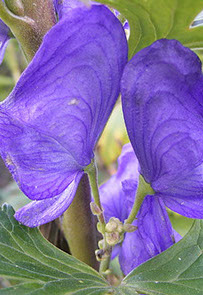
Aconitum carmichaelii, Wikipedia
COMMON NAME: Aconite
LATIN NAME: Aconitum carmichaelii
AKA: Monks’ Hood, Fu Zi
Common Name: Aconite, Prepared Aconite, Aconitum carmichaelii, Monks’ Hood, Fu Zi
Family: Ranunculaceae
Part Used: Prepared accessory root or branch root
Active Constituents: Aconitine, alkaloids; talatisamine; higenamine, salsolinol, coryneine, atisines, aminophenols
Actions: Anti-inflammatory, cardiac tonic
TCM actions:
1. Restores Depleted Yang, it treats Yang failure,
2. Tonifies Yang, Augment fire; in Kidney yang deficiency; cold, impotence, cold low back and knees; Spleen yang deficiency: loose stool and diarrhea; Heart Yang, deep weak pulse;
3. Warms the Channels, disperse Cold and dampness and relieves Pain.
Indications: Critical conditions of faint respiration, icy extremities, diarrhea containing undigested food, faint pulse; shock or heart failure; lower body edema; infertility and impotence; Bi Zheng syndrome due to cold; joint and muscle pain
Cautions: Do not use if consuming alcohol; side effects; overdosing will cause numb lips, tongue, or extremities, nausea or coma; Phaseolus, Lu Dou, is used to reduce the toxicity of Aconite Fu Zi.
Contraindications: Unprocessed herb is TOXIC; even processed herb is contraindicated during pregnancy, if yang excess and yin deficiency; prohibited for young neonatal patients.
Herb Drug Interactions: Fu Zi is incompatible with Bei Mu, Ban Xia, Gua Lou Shi, Bai Ji, and Bai Lian
Dosage (use animal doses where available, otherwise human doses can be included here but specify): Human: pre-decocted for 30-60 minutes: 3-15 gram Horses and Cattle: 15-30 g; Llamas, alpacas, goat, sheep and pigs: 3-10g; dogs: 1-3 gram; cats and rabbits: 0.5-1 gram; birds: 0.1-1 g
Notes: native to east Asia and Eastern Russia
Energetics: acrid, hot, sweet, toxic
Organs: Heart, Kidney, Spleen
Chen and Chen:
Fu Zi restores depleted yang by tonifying Heart Yang, thus opening channels and collaterals, and by tonifying Kidney Yang to augment fire; Fu Zi treats any type of yang deficiency, as it warms all of the organs and opens all of the channels and collaterals. The organs that are most susceptible to yang deficiency are Kidney, Spleen, and Heart. When prescribing this herb, the condition of the individual must be taken into consideration. Signs of overdose: involuntary salivation, nausea, vomiting, diarrhea, dizziness. (the signs are basically a proving of the herb itself.) Treatment of overdose: Rou Gui, Cinnamon; Sheng Jiang, fresh ginger; Gan Cao, licorice, Huang Lian, Coptis, Ren Shen, ginseng, and Huang Qi, Astragalus,
Xie:
Aconite is spicy and hot with a potent effect. It can tonidy the Heart Yang in the Upper Burner, Spleen Yang in the Middle Burner and the Kidney Yang in the lower Burner. It is a key herb for treating Yang deficiency or Yang Qi collapse. It is also an excellent herb for severe pain due to Wind-Cold- Damp. It is poisonous when raw; it is processed in a way that detoxifies it by involves soaking the herb in water for 1 week, mixing it with 4% Zingiberis, Sheng Jiang and 2 % Glycyrrhiza, Gan Cao, The herb is again soaked in water for 2 days; then steamed, sliced and dried. Aconite Wu Tou is related to Aconite Fu Zi. Both herbs come from the aconite plant but Wu Tou is the main root while Fu Zi is the branches from the main root. There are two subtypes of Wu Tou; Aconiti Kusnezoffii Radix, Cao Wu and Aconiti Carmichaeli Radix, Chuan Wu; Chuan Wu is hotter, more toxic and stronger for clearing Wind-Cold-Damp Bi that Fu Zi. Cao Wu is usually wild rather than cultivated and is even more toxic and potent that Chaun Wu; it is rarely used.
Scudder:
The small frequent pulse is the prominent symptom in acute diseases of children. With it alone many cases of infantile fever can be successfully treated. Aconite will be indicated in many cases of tracheitis, bronchitis, and pneumonia, which it relieves the local irritation and hyperemia, in addition to its general sedative effect. Aconite is a favorite remedy in the early stage of tonsillitis, or quinsy. It is the remedy in mucous and in many cases of pseudo-membranous croup. It has a specific influence upon the mucous membrane of the intestinal canal, relieving irritation. Thus it is a very common remedy for diarrhea, combined with ipecac.
Recent Research: Fuzi-cake-separated moxibustion at Zhongji (CV 3) and Guanyuan (CV 4) can better prevent post-operative dysuria, effectively promote the functional restoration of the urinary bladder, and control the incidence of post-operative dysuria; has anticancer effects on HepG2 cells and it is a potential reagent for the treatment of HCC; analgesic activities; Aconitum tanguticum has been widely used as a remedy for infectious diseases in traditional Tibetan medicine in China; protective effect in lung injury