

Dedicated to Developing Responsible Herbal Practice
Established in 2002 by Susan Wynn, DVM, CVA, CVCH, AHG

AGRIMONY
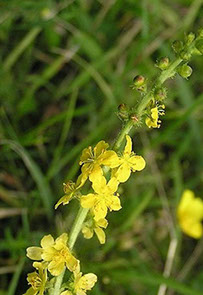
Agrimonia eupatoria, Osi, Wikipedia
COMMON NAME: Agrimony
LATIN NAME: Agrimonia eupatoria
AKA: Cockleburr, Stickwort
Agrimony: *Agrimonia eupatoria*, also called cockleburr and stickwort, is a hardy perennial that grows up to 1 meter. It is native to the Northern hemisphere, and likes to live in woods and fields. Not sure what to make of this but in Leechcraft: Early English Charms, Plantlore and Healing; is says that Agrimony could be slipped under a man's pillow and he then could not wake till it was removed.
Part used: herb, but also root and seeds
Temperature: neutral
Taste: sour-astringent, slightly bitter
Organs: In,St, Sp, Liver, GB, Kid, Bl
Chinese Action: (from *Ross and Holmes*)
1. tonify Spleen, astringe Intestines- bitter tonic, anti-inflammatory-treats malabsorption due to intestinal hypermeability
2. astringe Intestines, reduce diarrhea, and bleeding- astringent, antihemmorrhagic, anticatarrhal- treat colitis, diarrhea
3. tonify and regulate Liver-hepatic tonic, hepatoprotective, cholagogue-hepatic weakness and congestion with jaundice, cholecystits, or hepatitis B
4. Move stagnant Qi and clear Damp and Phlegm in Kidney and Bladder-anti-inflammatory; treats urinary incontinence, urinary tract inflammation, urinary dribbling,
5. Lung Phlegm Damp/heat-resolves mucous damp, removes congestion and stops discharge and bleeding; relieves wheezing
No known contraindications (BHC2) No data available on pregnancy and lactation; no known side effects, no data available on overdose and no drug interactions reported (CommissionE).
HOLMES
Peter Holmes writes: this botanical is suited for cases of mild to medium severity in sensitive people, children, and the elderly. It achieves a delicate union of restoring and draining. It is an excellent tonic astringent with mucostatic, homoeostatic,anti-diarrheal and anti-discharge actions. Agrimony's generous supply of the trace element silica ensures tissue restoration in those areas of its tropism. Agrimony is the ideal herb for mixed or complex disharmonies. Its real strength lies in its ability to alter chronic excess conditions of congested mucous damp that originally arose from deficiency. Classified as a mild remedy with minimal chronic toxicity.
TIERRA
It may be used as a supository, combining the extract with cocoa butter and insering into the rectum for hemorrhoids, tapeworms, and diarrhea. Because of its bitter taste, it is a specific for cheldhood diarrhea, appendictis, mucous colitis and urinary incontinence, and is a digestive bitter tonic remedy.
CULPEPER
It is of a cleansing and cutting faculty, without any manifest heat, moderately drying and binding. It openth and cleanseth the liver, helpeth the jaundice, and is very beneficial to the bowels, healing all inward wounds, bruises, hurts, and other distempers. It is good against the biting and stinging of serpents, and helps them that makes foul, troubled, or bloody water, and makes them urinate clear speedily; it also helpeth the colick, cleanseth the breast, and rids away the cough. A draught taken warm before the fit, first removes, and in times rids away the tertian, or quartan agues. ..stays the bloody flux; outwardly applied, it helpeth old sores, cancers, and inveterate ulcers, and draweth forth thorns and splinter of wood, nails, or any other such thing gotten into the flesh; it helpeth to strengthen the members that be out of joint; and being bruised and applied,it helpeth foul and imposthumed ears. It is a most admirable remedy for such whose lives are annoyed either by heat or cold. The liver is the former of blood, and blood the nourisher of the body, and Agrimony a strengthener of the liver.
COOK
The roots are a bitter yet rather aromatic astringent with some stimulating power. They are seldom used but valued in calculous difficulties. The herb is a mild stimulating astringent; not at all irritating; strengthening to the mucous structures; and acting somewhat on the skin and kidneys...It is a superior tonic for the kidneys. It is used for passive and bilious diarrhea, bloody flux, and leucorrhea. It is also useful for passive uterine hemorrhage, and spitting of blood. It enjoys a popular reputation in chronic coughs with excessive expectoration; is a good gargle in aphthous sores and sore throat; and may be used to some advantage as a wash in purulent. granular and gonorrheal ophthalmia. It has been commended in obstructed menstruation, asthma, scrofula and jaundice. It is useful for the enuresis of children.
FELTER
Specific Indications-Deep-seated colicky pain in lumbar region with uneasy sensations reaching from kidneys and hips to the umbilicus; atony or irritation of the urinary tract, with muddy, ill-smelling urine. Actions and therapy- a mild tonic and astringent, considerable value in cystic catarrh and nephritic irritation from the presence of gravel. It is also used as a gargle, and internally for mucous profluvia from any mucous structures of the body. We have know it to give relief in abdominal pan due to faulty intestinal digestion. Dribbling of urine in old persons is said to be relieved by Agrimony.
ELLINGTON
Therapy: It is valuable in the treatment of erysipelas and scrofulous affections. It inhibits excessive action of the mucous membranes, giving tone to the mucous tissues In chronic bronchitis and asthma and in the earlier stage of consumption, it was especially advised. It corrects chronic inflammatory conditions and relieves general irritability. Excessive mucous discharge are promptly relieved by agrimony. The atonic and relaxed mucous membranes which secrete excessively are restored to normal tone and normal functional activity by its use. Bronchorrhoea and leucorrhoea, chronic ulcerative gastric catarrh as well as colitis, ileocolitis, proctits and cystitis, all come within the range of its influence. In ulcerative stomatits, with foul smelling breath, it may be used alone or in conjunction with astringent alterative,as quereus alba, alnus or geranium. Agrimony is useful in a form of dysuria which affects women and girls, who are suffering from some form of dysmenorrhea. With this there is often an irritable condition of the bladder. At the same time there may be hysterical symptoms which result from uterine or ovarian congestion, which on its part, may be increased by the urinary irritation. This remedy seems to soothe the nervous system with it quiets the local irritation of the bladder. Pain due to chronic renal or cystic inflammation is relieved by it through its direct influence upon the pathological processes.
DR. BACH
*Dr. Bach* holds that Agrimony is the superlative remedy for tension. It is for the person who tries to hide his or her tension behind a false facade of suave sophistication or cheerfulness. He denies the pain with a smile. Argimony people like speed and danger to escape from their pain.
WOOD
Agrimony is specific in any condition where the person holds their breath to stop the pain. As an astringent, agrimony has been used for all sorts of digestive problems, but it is suited to those where tension and relaxation combine to cause incorrect timing of functions. Circulation to the liver, gallbladder, and gastrointestinal are off so that the hepatic cells do not receive the correct amount of "life-giving" arterial blood when they receive the dose of toxin laden blood from the portal vein and the intestines. Consequently, there are liver problems, allergies, skin rashes and wasting. Treats tissues states of constriction, relaxation and atrophy Preparation: Pick the leaves off the sides of the stem, leaving the leader to go into seed, in early summer, before flowering. Harvested after flowering, they are less sweet and more astringent.