
Dedicated to Developing Responsible Herbal Practice
Established in 2002 by Susan Wynn, DVM, CVA, CVCH, AHG

ALCHORNEA
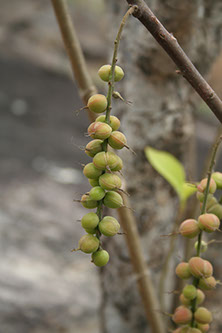
Alchornea cordifolia, Marco Schmidt
COMMON NAME: Alchornea
LATIN NAME: Alchornea cordifolia
AKA: Christmas bush, dovewood, bugi-bugi
Common Name: Alchornea cordifolia, Alchornea laxiflora; Alchronea; Christmas bush, dovewood, bugi-bugi
Family: Euphorbiaceae
Part Used: leaves are mostly used, but also the stem bark, stem pith, leafy stems, root bark, roots and fruits
Active constituents: The leaves, roots and stem bark contain terpenoids, steroid glycosides, flavonoids, tannins, saponins, carbohydrates and the imidazopyrimidine alkaloids alchorneine, alchornidine, and several guanidine alkaloids. The leaves also contain a range of hydroxybenzoic acids: gallic acid and its ethyl ester, gentisic acid, anthranilic acid,protocatechuic acid, and ellagic acid (alizarine yellow).
Actions: Antibacterial, antimalarial, antimicrobial, antiprotozoal, antifungal, antiamoebic, trypanocidal, anthelmintic, anti-inflammatory, antianemic, and antidiarrhoeal; antioxidant; antitumor, antiseptic, antiviral; prevents the sicklying of RBCs in sickle cell anemia-antidrepanocytary activity); sedative and antispasmodic activities
Indications: RBC protectant in Bartonellia; anemia, malaria, sickle cell anemia, trypanosomiasis; variety of respiratory problems including sore throat, cough and bronchitis, genital-urinary problems including venereal diseases and female sterility, and intestinal problems including gastric ulcers, diarrhoea, amoebic dysentery and worms; ulcers of the mouth, toothache and caries. Crushed fresh leaves or powdered dry leaves are applied externally as a cicatrisant to wounds, to relieve pain, e.g. backache and headache, to fractures to improve healing and to treat eye infections and numerous skin afflictions including venereal diseases, sores, abscesses, yaws and filariasis.
Cautions: Large doses may have a sedative or depressant effect of the CNS; high doses are emetic; used traditionally as an abortifacient, so caution during pregnancy
Contraindications: None reported
Herb Drug Interactions: None reported; but large doses should not be taken with CNS depressants or sedatives.
Dosage (use animal doses where available, otherwise human doses can be included here but specify): Human: tincture: ¼ tsp QID
Notes: Alchornea cordifolia is a shrub or small tree distributed throughout tropical Africa. Very common, sun-loving shrub or small tree of wet situations, common in secondary bush, sometimes climbing. Simple, cordate leaf with distinct glands at the base of the lamina; one pair of basal laterals; venation scalariform; Alchornea cordifolia occurs from Senegal east to Kenya and Tanzania and south throughout Central Africa to Angola. It is cultivated in DR Congo for its medicinal use. The plant is used in traditional African medicine
Stephen Buhner: Alchornea castaneifolia is not interchangeable with Alchornea cordifolia. The herb is widely disseminated within the body and shows strong impacts in the brain and CNS. It has a number of potent effects in the spleen. It generates a lymphoproliferative effect on naïve murine splenocytes and thymocytes and modulates the effects of the phagocytic and lysosomal enzyme activities of murine macrophages. Alchornea is widely used throughout Africa; used for urinary, respiratory and gastrointestinal disorders, for asthma and cough, as a wash for eye infection and topically for skin infection.
Historically: Senegal a leaf decoction is taken to treat tachycardia. Young stem pith is bitter and astringent and is chewed for the same use. The pith may also be rubbed on the chest to treat respiratory problems. The leaves are eaten in West Africa and Congo as an emmenagogue and to facilitate delivery, and in Gabon as an abortifacient. A cold infusion of the dried and crushed leaves acts as a diuretic. Leaf and root decoctions are widely used as mouth wash to treat ulcers of the mouth, toothache and caries, and twigs are chewed for the same purposes. A decoction or paste of leafy twigs is applied as a wash to treat fever, malaria, rheumatic pains, enlarged spleen and as a lotion or poultice to sore feet; vapour baths can also be taken. In Côte d’Ivoire and Ghana the leaves are applied as a haemostatic to stop prolonged menstruation and a decoction of roots or leaves is applied in the vagina to stop post-partum hemorrhage and to treat vaginitis. In Sierra Leone and Congo young leaves or pounded bark are made into a suppository to treat hemorrhoids. In DR Congo bruised leaves are applied as an enema to treat impotency. In West Africa pulped root is widely taken to treat venereal diseases. Dried leaves or roots, alone or with tobacco, are smoked to cure cough. The leaves and root bark are externally applied to treat leprosy and as an antidote to snake venom. In Gabon and Congo a root decoction or maceration is taken to treat amoebic dysentery and diarrhoea and used as eye drops to cure conjunctivitis. In Nigeria a decoction of bruised fruit is taken to prevent miscarriage. The sap of the fruit is applied to cure eye problems and skin diseases. In veterinary medicine a leaf or root infusion is given to livestock to treat trypanosomiasis. In Nigeria the stem bark is thrown in dammed streams as a fish poison. Alchornea cordifolia is used for alley cropping for in-situ mulch production in banana or maize plantations in West and East Africa. In Burkina Faso the plant is used as a windbreak around crops. In West Africa the leaves are used as forage for small ruminants and poultry. Chicken produce egg yolks with a deeper yellow colour when fed regularly with the leaves. In West Africa the leaves are used for packing cola nuts and ‘okpeye’, a Nigerian condiment produced by fermenting seeds of Prosopis africana (Guill. & Perr.) Taub. Pipe stems are made from the branches with the pith removed. The Iwo people of Nigeria chew the leaves as an appetizer. Dried leaves are a tea substitute. In West Africa mats and cloth are cooked with the fruits and natron to colour them black; the fruits are often combined with fermented Parkia pods or the bark of Bridelia ferruginea Benth. This dye is also used on pottery, calabashes and leather. The leaves are often added to indigo to darken its colour. In Nigeria fishermen use leaves and fruits for dyeing and preserving fishing nets; dried leaves give a darker colour than fresh ones. In Gabon bark and leaves are used to blacken cloth and pottery. The wood ash serves as a mordant. The wood is light, soft and perishable and is used for house construction, stakes and kitchen utensils, and also benches when large stems are available. The wood is also used as fuel. In DR Congo the split stems are used to line baskets. In Cameroon and Gabon the acidulous fruits are considered edible and are also used as bait to trap birds. The infructescences are used in decorations. Alchornea cordifolia extract has been patented for various other applications: antifouling adjuvant in paints, coatings and polymers, and alchorneic acid was proposed as a raw material for hemi-synthesis of plastic.
Published research: hepatoprotective, strongly anti-inflammatory by inhibiting neutrophil elastase and superoxide anion; Different leaf, stem bark and root extracts (macerations or decoctions and methanolic, ethanolic or acetonic extracts) have shown significant activities against a range of bacterial and fungal pathogens of humans. The root bark showed the strongest activity. The results of tests on anti-HIV activities of the seed extract are contradictory; in African tests, HIV-1 strains were sensitive to the seed extract, whereas American tests seemed inconclusive. Methanol or ethanol extracts of leaf and root at a concentration of 100 μg/ml did not show cytotoxic activity against 60 different tumour cell lines from 8 organs. The ethanol extracts of the leaf and fruit showed significant trypanocidal, anthelminthic and amoebicidal activities. The amoebicidal activity of the root bark was even much higher. The ethanol extract of the leaf exhibited mild in-vitro activity against Plasmodium falciparum, whereas chloroform and ether extracts were inactive. Ellagic acid was found to be the active constituent of the extract. Crude ethanol extracts of the leaves showed moderate in-vitro anthelmintic activity against Haemonchus contortus, a nematode pathogenic to small ruminants. Different leaf extracts showed a significant anti-anaemic activity by increasing the level of haemoglobin and iron in the blood after oral administration to anaemic rats. Crude extracts of the leaves coagulated blood plasma in vitro. The high tannin content was thought to be responsible for this activity. The ethanol extract of the leaf showed significant activity against castor oil-induced diarrhoea in mice. The presence of tannins and flavonoids may account for the increased colonic water and electrolyte reabsorption. The crude methanol extract of the leaf has a moderate relaxing effect on smooth muscles in vitro, which is attributed to the flavonoid quercetin and its derivatives. The ethanol extract of the root significantly delayed the effect of histamine-induced broncho-constriction characterized by shortness of breath in guinea pig. The crude methanol extract of the leaves and several fractions of it have shown anti-inflammatory activity in the croton oil-induced ear oedema test in mice and in the egg albumen-induced hind paw oedema test in rats. The cytotoxicity of the crude extract was very low. Alcohol extracts from root bark, stem bark, leaves, fruits and seeds disrupted mitotic cell division in onion (Allium cepa L.). A methanol extract of the seed has shown inhibition of vascularization in chicken embryos. The approximate nutrient composition of leaf meal for use in chicken feed was per 100 g dry matter: energy 1930 kJ, crude protein 18.7 g and crude fibre 16.4 g. While the production of leaves is high, their palatability to cattle, goats and sheep is rather low.