
Dedicated to Developing Responsible Herbal Practice
Established in 2002 by Susan Wynn, DVM, CVA, CVCH, AHG

AMERICAN BITTERSWEET
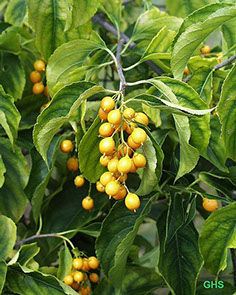
Celastrus scandens, Wikipedia
COMMON NAME: Am. Bittersweet
LATIN NAME: Celastrus scandens
AKA: False bittersweet, Staff-vine, Wax work
Common Name: American bittersweet, Celastrus scandens, False bittersweet, Staff-vine, Wax work
Family: Celastraceae
Part Used: Root cortex
Active constituents: Flavonoids
Actions: Tonic, alterative; astringent; analgesic, anti-microbial, anti-oxidant; ani-tussive
Indications: Scrofulous cases; glandular swelling; strumous diathese; skin disease; leucorrhea and obstructed menstruation; nocturnal urinary incontinence; Pain relief for labour pain, toothache pain; coughs; topical for udder congestion
Cautions: Berries considered a poison
Contraindications: Had been used traditionally as an abortifacient; not to be taken when pregnant
Herb Drug Interactions: None reported
Dosage (use animal doses where available, otherwise human doses can be included here but specify): Human: Decoction-2-3 oz. TID
Notes: *C. scandens* is native to central and eastern North America. It was given the name *Bittersweet* by European colonists in the 18th century because the fruits resembled the appearance of the fruits of Eurasian Nightshade (*Solanum* *dulcamara*, which was also called *Bittersweet*. It has a sturdy vine that may have twining, woody stem that are 30 feet(9.1 m) or longer and an inch or more thick at the base. The stems areyellowish-green to brown and wind around other vegatation, sometimes killing sapling by restricting further growth. It has tiny, scentless flowers at the tips of the branches. It has colorful, orange fruit that are the size of a pea. These fruits are poisonous to humans when ingested internally, but are favorites of birds.
Taste: Sweet somewhat nauseous
Cook: Specific for young women about the age of puberty, when they get blue bands under their eyes with general paleness, precarious appetite, nervousness, feebleness, and vaginal weakness. Outwardly, a strong decoction of this agent makes a good wash in chaffiness of the skin and scaly eruptions, especially when the surface is hot. It is used in poultices, salve and a strong decoction with flannel, upon glandular swellings and has a soothing and softening action. It has been highly
spoken of outwardly and inwardly in cancers; useful on caked breasts and other lymphatic enlargements in strongly scrofulous constitutions.
S.B. Dodd, M.D.: used it for diabetes; one once of the solid extract with ¼ of ounce of extract of Hydrastis, softened to the consistence of molasses with a whiskey tincture of Colombo and dogwood
Traditional Native use: Labour pains; roots chewed as and anti-tussive; infusion of bark used to settle the stomach and decoction given for bowel complaints.* Chippewa* used boiled roots as an ointment for cancer; or for any obstinate sores; decoction of root as a diuretic for stoppage of urine.*Iroquois*: used also as a decoction of roots used as wash on lips or gums of bad or teething Children. Gynecological aid: infusion of leaves and stems taken for fever and soreness from pregnancy.