

Dedicated to Developing Responsible Herbal Practice
Established in 2002 by Susan Wynn, DVM, CVA, CVCH, AHG

BACOPA
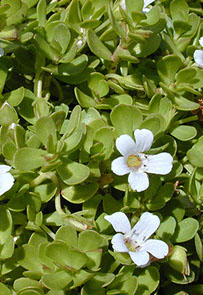
Bacopa monniera, Kim & Forrest Starr
COMMON NAME: Bacopa
LATIN NAME: Bacopa monniera
AKA: Indian Pennywort, Bacopa; Water Hyssop, Herb-of-Grace; Brahmi
Common Name: Bacopa, Bacopa monniera, Indian Pennywort, Bacopa; Water Hyssop, Herb-of-Grace; Brahmi
Family: Scrophulariceae
Part Used: whole dried plant; mostly leaves and stems
Active constituents: aloids; saponins, d-mannitol, hersaponin acid A; monnierin; Bacosides A and B (cognitive effects)
Actions: Nervine tonic, spasmolytic, mild sedative, mental tonic, cardiotonic, digestive, antiasthmatic
Indications: Decreased mental acuity, depression, anxiety, stress, stress-related bronchitis and diarrhea; epilepsy, for mild sedation and for complementary anticonvulsant therapy; anxiolytic as a nervine, hypothyroidism; asthma; irritable bowel syndrome, gastric ulcers; protection in cardiovascular disease and some cancers; Vaccinosis as protective of mercury damage
Cautions: Bacopa will absorb any toxins that are found in the soil in which it is growing. It is mildly stimulating to the thyroid gland.
Contraindications: No adverse reactions reported
Herb Drug Interactions: Decrease the toxicity of morphine and phenytoin; ay potentiate the activity of thyroid-stimulating drugs or inhibit the effects of thyroid-suppressant drugs; caution is used with sedatives, may potentiate the effects of pentobarbitone and phenothiazines.
Dosage (use animal doses where available, otherwise human doses can be included here but specify): Human: Dried herb: 2-10 gm TID; Syrup: 30 mL daily; Infusions and decoctions: 5-30 gm per cup; 1 cup TID-6X; Tincture:1:2 or 1:3: 1 - 5 mL TID; Small Animal: Standardized extract: 3 - 10 mg/kg divided daily; Dried herb: 50 - 150 mg/kg divided daily; Infusion and decoction: 5-30 gm per cup, 1/4-1/2 cup per 10kg divided daily; Tincture 1:2 – 1:3 : 1.0-3.0 mL per 10kg divided daily
Notes: Native in tropical regions; India and Australia. It is a low-growing herb which grows easily in moist and damp areas such as stream beds. It is easily cultivated if adequate water is available. Its flowers and fruit appear in summer.
Energy: Cold, astringent, sweet.
Sodhi: Bacopa is the basis for a number of important Ayurvedic herbal preparations; including Brahmighritam and Brahmirasayanam. It has been shown to have potential application in Alzheimer’s disease therapeutics; gastroprotective effects; cardioprotective activity; increases the levels of thyroid hormone; helps wound healing; has a potential ant-arthritic effect, has a protective effect against certain drugs and their side effects, including morphine withdrawal; and exerts cytotoxic activity against sarcoma-190 cells. Brahmi is an immune-modulation herb that also strengthens collagen. It provides excellent therapy for all auto-immune disease affecting tissues containing collagen, such as rheumatoid arthritis, lupus, lichen sclerosis, and scleroderma. It supports the skin and is used for wound and burn healing, both internally and externally. Brahmi is also a brain tonic. Dr. Sodhi uses Bacopa with Ginkgo biloba; convolvulus pluricaulis, Withania somnifera, and Gotu kola for Scleroderm; Bacopa is one of the major Ayurvedic herbs. It has been found in Indian texts as far back as the 6 th century. It is used mainly to promote the intellect and as a potent nervine, cardiotonic and diuretic and has a positive effect on asthma and certain types of insanity. It was used as a brain tonic to enhance memory development, learning and concentration, and to provide relief to patients with anxiety or epileptic disorders. David Winston uses this herb quite successfully on ADHD kids. It pacifies kapha and vata. Is is classifed as a nootropic, meaning works on the mind.
Recent Research: significantly higher antidepressant-like activity; can act as renoprotective agent by attenuating the renal oxido-lipidemic stress via regulating NOS level and thereby protects the nephron in hypercholesterolemic rats; antioxidant and cytoprotective property; protects PC12 cells against SNP-induced toxicity via its free radical scavenging and neuroprotective mechanism. ameliorates various impairments associated with neuronal and physiological changes in rats exposed to crackers smoke by its potent neuromodulatory, antioxidant and adaptogenic propensity. has a potent efficacy to alleviate MeHg-induced toxicity in rat cerebellum; useful for therapeutic treatment of clinical conditions associated hypercholesterolemia; Bacopa monniera extract exhibited calcium channel blocking activity in guinea-pig tracheal smooth muscles; ameliorates the autistic symptoms possibly due to its anti-anxiety, antioxidant and neuro-protective activity; endogenous adrenergic, serotonergic and opioidergic systems are involved in the analgesic mechanism of action of the aqueous extract of Bacopamonniera; have neuronal dendritic growth stimulating properties; have neuronal dendritic growth-stimulating properties; therapeutic effect of B.monniera in ischaemic heart disease; strong antioxidant and few radical scavenging properties; antiaging effects; cognition-enhancing effects.