

Dedicated to Developing Responsible Herbal Practice
Established in 2002 by Susan Wynn, DVM, CVA, CVCH, AHG

BIDENS PILOSA
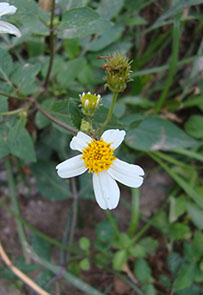
Bidens pilosa, Vishesh Bajpai
COMMON NAME: Bidens Pilosa
LATIN NAME: Bidens pilosa
AKA: Xian Feng Cao, beggar's tick, beggar-ticks, hairy beggar-ticks, black-jack, broom stick, broom stuff, cobbler's pegs, devil's needles, hairy bidens, Spanish needle, farmers friend, stick-tight
Common Name: Bidens pilosa, Xian Feng Cao, beggar's tick, beggar-ticks, hairy beggar-ticks, black-jack, broom stick, broom stuff, cobbler's pegs, devil's needles, hairy bidens, Spanish needle, farmers friend, stick-tight
Family: Asteraceae
Part Used: Whole plant; more active as an antibacterial and mucous membrane protectant if its is prepared fresh
Active constituents: polyacetylenes and flavonoids, chalcone okanin, and ethyl caffeate, a hydroxycinnamic acid
Actions: Clear Heat and Toxins. Alterative, antibiotic, antibacterial, antidysenteric, anti-hemorrhagic, anti-inflammatory ; anti-malarial, antimicrobial, antipyretic, astringent, carminative, circulatory promoting, emmonagogue, emollient, hepatoprotective, hypotensive; immune modulator; intoxicant, lactogogue, liver protectant, prostaglandin synthesis inhibitor; mucus membrane tonic, sialogogue; vulnerary; neuroprotectent against neurotoxins;
TCM Actions: 1.Cools and resolves the surface; 2. Clear heat toxins, removes toxins, removes stagnation; 3. Invigorates blood; 4. Clears Damp Heat form Lower Jiao; 5.Removes Wind Dampness; 6. Purges Fire; 7. reduces swelling
Indications: Colds and Flu; bacterial infections; acute or chronic hepatitis; inflammatory conditions, urinary tract infections; Co-infections in Lyme disease. Young leaves, fresh or dried are used as a food in Sub-Sahara. Appendicitis, nephritis, dysentery, haemorrhoids, topical for toxic swellings. Systemic staph, malaria, babesia and Leishmania; probably Mycoplasma; Increases insulin sensitivity
Cautions: Can stimulate labour; caution if pregnant; administer carefully for patients with deficiency and cold of the Spleen and Stomach
Herb Drug Interactions: Can potentiate tetracycline. Caution if on diabetic medications as the herb can alter you blood glucose and insulin levels.
Dosage (use animal doses where available, otherwise human doses can be included here but specify): Human: dried herb 6-15 gram in decoction; fresh plant tincture: 45-90 drops four times a day.
Notes: It grows aggressively on disturbed land and land that is dry and infertile. Native to temperate and topical Americans but was introduced to Asia and the Pacific Islands; often considered a weed in topical habitats.
Energetics: Bitter, bland, sweet; neutral to cool
Channels: Kidney, Small Intestines, Urinary Bladder
Native American use: Cherokee: anthelmintic; chew leaves for sore throat; Seminole: analgesic and antidiarrhoeal; eye disease, headache, high fever, and diarrhea; antirheumatic; used for fire sickness; fever and body aches; infusion of roots taken for sun sickness; eye disease; high fever, and diarrhea; infusion of plant for a bath for mist sickness; Paiute: used for food; Hawaiian use: infusion of pounded flowers for appetite stimulant; used as a paediatric aid for general debility; respiratory aid, and asthma treatment; throat aid.
Cook:
The seeds are a diffusive stimulant and relaxant, promoting expectoration, and securing a good outward flood of blood. They soothe and sustain the nervous system, and seem also to be of benefit in light cases of painful and deficient menstruation. Some physicians consider them of great efficacy in painful menstruation, especially as accompanied by palpitation, general nervousness, or other light hysterical symptoms. They are generally given in warm infusion. The root is said to be a good tonic expectorant in chronic cough; and the leaves are reputed diaphoretic and emetic, capable of relieving membranous croup. The leaves can be used as a local application to arrest the flow of blood, and used as a wash in poles, nose bleeds, bleeding gums, etc.
Chen:
Can be used as an iced beverage or tea in summertime to relieve summer heat.
Buhner:
believes that Bidens is active against Mycoplasmas; one of the most potent PGE2 plant inhibitors known; especially good for any systemic infection that is accompanied by problems in Mucous membranes, diarrhea, dysentery, UTI, vaginitis, and inflamed respiratory passages, systemic staph, malaria, babesia and Leishmania. With its affinity to heal mucus membranes, it is well suited for UTIs that are treated, return, are treated, return, ad inuretherum, especially if antibiotics have been used. It is specific for reducing elevated levels of uric acid in the blood.
Recent research: suppress T-cell leukaemia; natural remedy for coccidiosis with low drug resistance in chickens; has anti-HSV activity; potentially therapeutic value against colorectal cancer; antidiabetic activity; used by Amazonian and Asian folks for some hepatopathies and shown to be effective; prevents the progression of acute gastric mucosal lesions; could be used in the phytotherapy of the hepatic damage induced by chronic obstructive cholestasis, because protects liver function, decreases the rate of necrosis and liver fibrosis in cholestatic liver disease; inhibit histamine release; ameliorates type 2 diabetes in db/db mice via regulation of insulin secretion and islet protection.; anticancer and antimalarial activity; candidates for anti-angiogenic therapeutics; ability to inhibit MAPK, mainly p38, activity, COX-2 expression, and subsequent PGE(2) production; protective antioxidant properties; proven to be active against P. falciparum drug-resistant parasites; antihypertensive effect in part by improving insulin sensitivity; useful medicinal plant for treating leukemia.