
Dedicated to Developing Responsible Herbal Practice
Established in 2002 by Susan Wynn, DVM, CVA, CVCH, AHG

BITTERSWEET
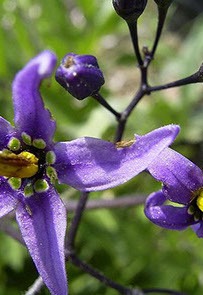
Solanum dulcamara, TeunSpaans
COMMON NAME: Bittersweet
LATIN NAME: Solanum dulcamara
AKA: Bitter Nightshade, Woody Nightshade, Poisonberry
Common Name: Bitter-sweet, Solanum dulcamara, Bitter Nightshade, Woody Nightshade, Poisonberry
Family: Solanaceae
Part used: Twigs; root bark; Dried young branches after leaves have fallen (BHP); extract from young leaves can also be used
Active constituents: Dulcamarin, solanine, gum, resin, wax. (Solanine may be obtained from the new sprouts of ordinary potatoes.)
Actions: Alternative, diuretic, diaphoretic, discutient, narcotic
Indications: Any condition from a suppression of secretions, and exposure to cold and damp; acute coryza, with bronchial and nasal catarrh, bronchial asthma, and acute bronchitis; eruptive fevers, pustular eczemas, psoriasis, pityriasis, lepra and other scaly skin disorders; scrofula and other blood disorders; catarrh of the bladder, and a stimulant to urinary secretion; chronic rheumatism.
Cautions: Toxic if taken in large doses; berries are felt to be poisonous.
Contraindication: Pregnancy; lactation
Herb Drug interactions: Potential with narcotics
Dose (use animal doses where available, otherwise human doses can be included here but specify): Human: Fluid extract: ½ to 2 drachms. Today commonly available in a homeopathic form.
Notes: It is a perennial, shrubby plant, quite woody at the base but throws out ling, straggling, slender branches, which trail over the hedges and bushes.
Linnaeus:
spoke of it in the highest terms as a remedy for rheumatism, fever and inflammatory diseases of all kinds.
Ellingwood:
This agent is a powerful poison to all living protoplasm. (*In Toxic Doses*) It coagulates the blood and destroys the integrity of the corpuscles. It is a narcotic, and in toxic doses causes nausea, vomiting, faintness, pain in the joints, numbness of the limbs, dryness of the mouth, convulsive movements, a small hard pulse, paralysis of the tongue, a purplish color of the face and hands, twitching of the eyelids and lips, trembling of the limbs, erythematosus eruptions
Titus:
used Bittersweet in his Ointment for Stiff Joints or Relaxing Ointment No.3. He used the root bark.
Gerard:
said, “The juice is good for those that have fallen from high places and have been thereby bruised or beaten. For it is thought to dissolve blood congealed or cluttered anywhere in the intrals and to heale the hurt places.”
Bitter-sweet is woody nightshade, *Solanum dulcamara*. Taken internally, this can be a powerful poison and can cause coagulation of the blood destroying the integrity of the corpuscles. Topically, it has a direct action upon the skin. It acts as an alterative and can influence the skin from disordered blood. (Ellingwood, 1919) Dulcamara is used homeopathically to treat rheumatism caused by damp conditions. Dulcamara was considered to be a valuable remedial agent in any disease that resulted from cold. In rheumatism, resulting from long-continued exposure to cold and dampness, it is considered to be very valuable. (*Fyfe,* 1909) * Scudder* considered it specific in chronic conditions in which the circulation is feeble, the hands and feet cold and purplish, with fullness of tissues and tendency to edema.
Studies have shown a Solanum extract to have a concentration-dependent vasorelaxant effect on endothelium. It was suggested that a NO pathway was involved.
Solanum rostratum Dunal (Solanaceae) induced concentration-dependent contraction of rat aortic rings, suggesting that these plants have benefits for the treatment of ailments caused by as venous insufficiency. Venous insufficiency would be another typical problem with poor healing, chronic joint and tendon injuries.