
Dedicated to Developing Responsible Herbal Practice
Established in 2002 by Susan Wynn, DVM, CVA, CVCH, AHG

BURDOCK
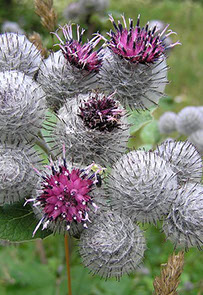
Arctium lappa, Epukas
COMMON NAME: Burdock
LATIN NAME: Arctium lappa
AKA: Nui Bang Zi, gobo, Great burdock, cockle buttons
Common Name: Burdock, Articum lappa L., Nui Bang Zi, gobo, Great burdock, cockle buttons.
Family: Asteraceae (Compositae)
Part Used: Air-dried root; leaves and fruit
Active constituents: Inulin, mucilage, sugar, flavonoids, bitter glycosides, Lignans, acetylenic compounds, phenolic acids, and the roots contain starch.
Actions: Depurative, anti-cancer, anti-oxidant, mild antiseptic, Antimicrobial, anti-inflammatory, alterative, dermatological agent, diuretic, laxative, antiarthritic, TCM: 1. Clear Wind (heat) promotes sweating, reduces fever and promotes eruptions and clears retained pathogen, 2.Clear Heat Toxic heat and Retained Pathogen, anti-dotes poisoning, 3.Assist Kidney and Bladder to drain Damp, treats Kidney yin deficiency; 4. Moisten and nourish skin, clear Wind Heat and Retained pathogen, 5. Promotes Detoxification, Clears Damp. Dissolves deposits, removes lymph congestion, promotes urination and relieves irritation-treats Damp/cold obstructions; kidney qi stagnation; 6. Stimulate digestion, promote bile flow, removes accumulations; raises qi and relieves prolapses.; can treat intestinal dysbiosis; 7 Promotes tissue repair and benefits the skin.(From Peter Holmes who also noted to always think of Burdock when there is a skin/bladder underlying disharmony since it has an overall diuretic/diaphoretic and detoxicant effect.)
Indications: Recurring urticaria, allergic eczema; psoriasis, acne, boils, arthritis, rheumatism, gout, lymphadenitis, adjunct to cancer therapy; secondary herb for acute or chronic urinary tract inflammation or for obesity with edema; anti-tussive esp. in cats, any disorder that requires improved elimination from the body; use for a prebiotic; food, gobo; constipation ; endoparasite control in poultry, lowers blood cholesterol
Cautions: Watch for adulteration of product.
Contraindications: None found
Herb Drug Interactions: None reported
Dosage (use animal doses where available, otherwise human doses can be included here but specify): Small Animal: Dried herb: 25-500 mg/kg divided; Infusions: 5-30 g per cup of water, given ¼-1/2 cup per 20 pounds, Tincture: 1:2-1:3: 0.5-2.0 ml per 20 lbs. divided Human dosage: Capsules: 1 - 2 g 3 times per day,Dried root: steep 2 - 6 grams in 150 mL (2/3 of a cup) in boiling water for 10 - 15 minutes and then strain and drink 3 times a day; may soak a cloth in the liquid and, once cooled, wrap the cloth around affected skin area or wound. Do not use on open wounds; Tincture (1:5): 30 - 60 drops, once daily. Typically, burdock is combined in tincture form with other herbs. The tincture may also be applied to a cloth and wrapped around affected skin area or wound; Fluid extract (1:1): 30 - 60 drops, 2 times a day; Tea: 2 - 6 grams steeped in 500 mL water , 3 times per day. Horse and cattle: 15-39 g; Llamas, alpacas, goats and pigs-3-15 g.; birds: 0.2-1.5 g
Notes: common in Britain, Europe and Asia Minor, introduced to NA. It grows freely in waste areas; watch for embedded burs in dog’s tongue, can create “Burr Tongue”
Temperature: cool
Energetics: root: slightly acrid, slightly bitter; Seeds: acrid, slightly bitter, sweet; (Matt Wood classifies it as warm and sweet and bitter and pungent)
Organ: Kidney, Bl (Lu, LI)
Matthew Wood:
feels that Burdock is indicated when there is a tissue state that is characterized by dry/atrophy and stagnation. In this state the tissues need to increase secretions and the tissue needs feeding and cleansing.
The bitters in this plant will stimulate secretions in the digestive tract--hence better activity of the gallbladder. The oils found in Burdock also increase the secretion of bile, hence improved activity of the gallbladder. So constipations that are being caused by a lack of emulsification of fats and lipids are helped by Burdock.
Dry scaly skin, that is characterized by blocked sebaceous glands, due to a lack of oil moving, and then a secondary inflammation, is also healed by Burdock.
So Specific Indications of Matthew Wood-
Dry, lack of oil, Heat
Thin, withered people with dry skin and scalp.
Digestion-lack of secretion in the Upper G.I,/lack of lubrication in the lower GI tract
Poor glandular function
Liver congestion/gallstones
Leeches out concretion, Kidney stones, arthritis
Unbearable sciatic pain-better with movement
Carpal Tunnel syndrome
Fever with excessive Oily seating and worry
Dry or oily skin with eczema, acne, dandruff
Water retention in individuals who are generally dry
Hildegarde:
did not think that highly of burdock except "for a person who was born with a stone in his or her body"
Culpeper:
on Burdock "Venus challengeth this herb for her own..and by its leaf and seed you may draw the womb which way you please. (I have never tried this).
The Burdock leaves are cooling, moderately drying...food for old ulcers and sores. A dram of the roots taken with pine kernels helpeth them that spit foul, mattery, and bloody phlegm. The leaves applied to the places troubled with the shrinking of the sinews or arteries fine much ease. The juice of the leaves, or the roots ..helpeth biting of any serpents. The juice of the leaves being drank with honey provoketh urine, and remedieth the pain of the bladder. The seed being drank in wine forty days together, doth wonderfully help the sciatica. The leaves bruised with the white of an egg, and applied to any place burnt with fire, taketh out the fire. The decoction of them fomented on any fretting sore or canker, stayeth the corroding quality... the roots may be preserved with sugar, and taken for consipations, the stone, and the lask.( What is the lask?) The seed is much commended to break the stone, and cause it to be expelled by urine.
Ellingwood:
adds that ,“It is beneficial in syphilitic, scrofulous and gouty conditions.”
Cook:
adds the root is mainly relaxant and demulcent with a limited amount of tonic property. It acts slowly and mildly upon several of the secreting organs, as the kidneys, skin and bowels. This secures from it a gentle alterant action, of use in cutaneous, scrofulous, and scorbutic affections, particularly where there is an irritable condition of the system. Its action on the kidneys and bladder is available in irritable conditions of these organs. To the bowels, it favors a soft and natural openness. The seeds are more prompt in their impressions. They increase the flow of urine, their action on the skin is very good, and it abates the nausea of lobelia. The leaves make a good ointment in scrofulous ulcers.
Locke:
This agent is a much neglected alterative. It directly influences the renal apparatus, relieving irritation, increasing the flow of urine, and assisting in eliminating morbid material. It may be employed for the removal of worn-out tissues when the saline renal depurant would do harm. A tincture of the seeds is said to be one of the best of the few remedies for psoriasis. It certainly exerts a favorable influence upon dyspepsia, with a cachectic state of the blood. Both cough and bronchial pulmonary irritation are relieved by it when an alterative is demanded.
TCM:
the seed is used Niu Bang Zi: especially for its ability to benefit the throat, relieve toxins, and also to moisten intestines
Published research:
strong anti-inflammatory activity against acute liver damage, esp. drug induced; source of linolenic acid for dermatologic cases; lowers blood cholesterol; The lignan arctigenin (ARG) possesses anti-cancer activity, ARG selectively arrested the proliferation of cancer cells at the G0/G1 phase through the down-regulation of NPAT protein expression.; helps memory; Arctium lappa exert marked protective effects in acute experimental colitis, promotes regeneration of damaged gastric mucosa, therapeutic effect in ischemic stroke treatment through an anti-inflammatory mechanism, can inhibit HFCD-induced vascular inflammation, inhibitor of diabetic retinopathy.