|
| Veterinary Botanical
Medicine Association |
| Dedicated to Developing
Responsible Herbal Practice |
| |
| MEMBER WEBSITE |
| |
|
Jasmine C. Lyon,
Executive Director |
|
QUESTIONS?
email
office@vbma.org |
| |
| Established in 2002 by
Susan Wynn, DVM, RH(AHG) |
|
|
|
| |
|
|
| |
|
VBMA Herbal Wiki |
|
|
|
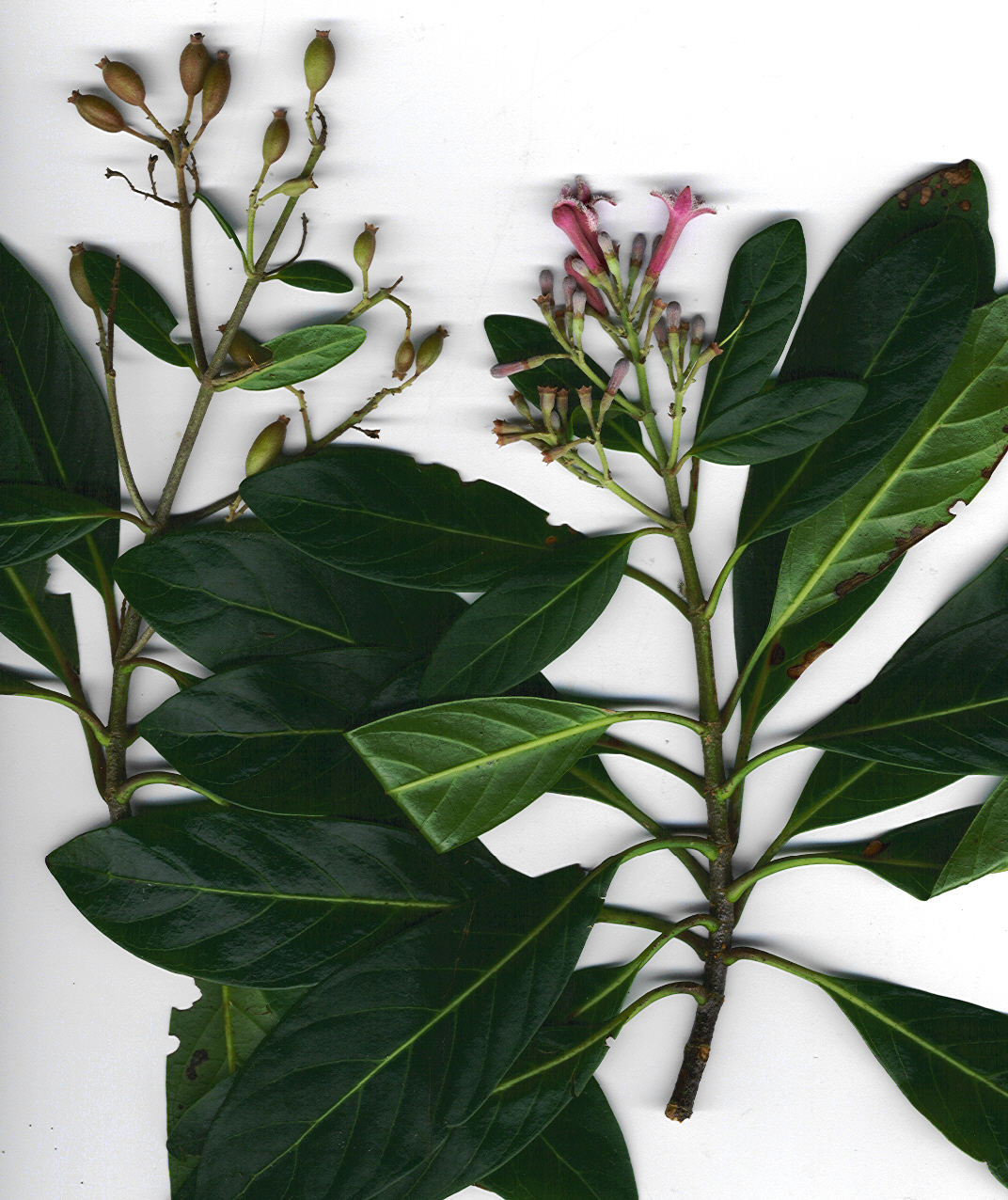
*Cinchona calisaya*; Cinchona
bark; Jesuit's bark; Peruvian bark- is an evergreen tree
with bark that turns reddish when cut. It is native to
tropical South America. . It is a magnificent tree,
two to three feet in diameter, sixty to one hundred and
twenty feet high, naked and erect, elevated above all
the other trees of the forest with a large leafy head.
*Cinchona condaminea*; called Pale Bark or Crown Bark
is a small and branched tree., a foot in diameter and
fifteen to twenty feet high. Several varieties yield a
product of the same general character. The more red the
bark, the stronger it will be. Cinchona was
introduced to Europe from Peru by the Jesuits to treat
malaria in the 1630's.
Temperature: cool
Taste: bitter
Organ: Ht, Sp and Liver
Action: (*Jeremy Ross*)
1. Clear retained Pathogen, clear Heat, clear Deficiency
Heat: antipyretic, antimicrobial, antimalarial
2. tonify spleen an Stomach Qi, tonify Qi and Blood- a
bitter digestive tonic, general tonic; helps to treat
digestive weakness,
3. tonify and stabilize Heart Qi- cardiac tonic;
antiarrhythmic; treats cardiac weakness with exhaustion
and or arrhythmia, chronic fatigue patients with cardiac
weakness, to assist recovery when Heart Qi and Yin may
have been destabilized by fever.
Cautions: Not much adverse reaction
reported but Jeremy Ross advises not during pregnancy or
lactation; may have potential for interactions with
antiarrhythmic drugs, cardiooactive glycosides,
beta-blockers, antihistamines, anticoagulants. Some
texts say to avoid if gastric ulcers are present. |
| |
| FELTER |
| Specific
Indications-Periodicity and, like quinine, effective
when the pulse is soft and open, the tongue moist and
cleaning, the skin soft and moist, and the nervous
system free from irritation Empyema; gastric debility;
anemia and debility from chronic suppuration, afternoon
febrile conditions weakness with pale surface, loss of
appetite, feeble digestion and deficient recuperative
powers. Action and Therapy-External-antiseptic and
astringent. A poultice of the bark has been
successfully used upon fetid and gangrenous ulcers, and
has been thought necessary upon suppurating and
sloughing felons. Internal: cinchona is tonic,
anti-periodic slightly astringent, and mildly
antiseptic. In small doses it is a good stomachic but
must not be long continued. Large doses irritate and
cause and unpleasant excitement of the stomach and
bowels. Cinchona is useful in functional derangement of
the stomach, improving digestion and imparting vigor
and tone to the nervous and muscular systems in disease
of general debility and in convalescence form exhausting
illness. Cinchona may be used in preference to its
alkaloids when a tonic effect only is required and
periodicity is lacking. |
| |
| COOK |
| The bark is a slow and very
permanent stimulant of the astringing order to the
nervous structures. Beginning its action upon the
stomach, it slowly and steadily extends its impressions
through, the sympathetic nerves; second, the sensory
nerves of the frame at large; third the spinal cord and
brain. It will scarcely reach this third circle of
influence , unless given in a considerable quantity, or
continued for some time. Accompanying this stimulating
action is its distinct astringent influence. (best seen
in the redder barks)This astringency is also manifested
upon the nerve structures, causing a protracted state of
tension in them. It is valuable in conditions of atony
and laxity of the tissues; and where there are excesses
of secretion consequent upon such atony. It is utterly
inappropriate when the structures are tense, and a
deficiency of secretion It is not a district tonic. The
chief use of this article is as an antiperiodic. Its
principal reputation is in averting the "chill" of ague
and other intermittent difficulties. As the chill is
dependent upon recession of blood from the surface to
the portal organs, and in itself constitutes nature's
first step in the effort to restore the circulation to a
balance, successful medication must fulfil three
indications: first, remove the hepatic obstruction and
accumulations which are the prime disturbers of the
circulation; second, sustain the firmness of the nervous
tissue, so as to avert that relaxation of these
structures which really forms the chill; third, secure a
full outward circulation, sot that the heart and
arteries shall be sustained simultaneously with the
nerves. Cinchonas fill only the second of these
requirements. On its own it cannot permanently cure an
intermittent. |
| |
| FYFE |
| *Fyfe *adds in by saying the
Cinchona constitutes an efficient medicament in malarial
and miasmatic diseases, when the tongue is moist and
clean, or cleaning. Cinchona is a valuable remedy in
all debilitated states of the stomach and digestive
tract, which are characterised by periodicity, and in
general debility and want of appetite it acts well as a
tonic. It is contraindicated in acute inflammatory
diseases,plethora, active hemorrhages, and all vascular
nervous irritations. When indicated, it is a good
tonic, and in many gastric derangements it is a remedy
of merit. It is used topically as a gentle stimulant
and antiseptic. |
| |
| CHRISTOPHER |
| *Christopher* adds use as a
heart tonic, nervine tonic for nervous disorders,
neuralgia, epilepsy, urinary incontinence, enuresis,
edema, amenorrhea. |
| |
| BHP |
| *BHP* adds in a potential use
for splenomegaly and myalgia. |
| |
|
|