 |
| Veterinary Botanical
Medicine Association |
| Dedicated to Developing
Responsible Herbal Practice |
| |
| MEMBER WEBSITE |
| |
|
Jasmine C. Lyon,
Executive Director |
|
QUESTIONS?
email
office@vbma.org |
| |
| Established in 2002 by
Susan Wynn, DVM, RH(AHG) |
|
|
|
| |
|
|
| |
|
VBMA Herbal Wiki |
 |
| COMMON NAME:
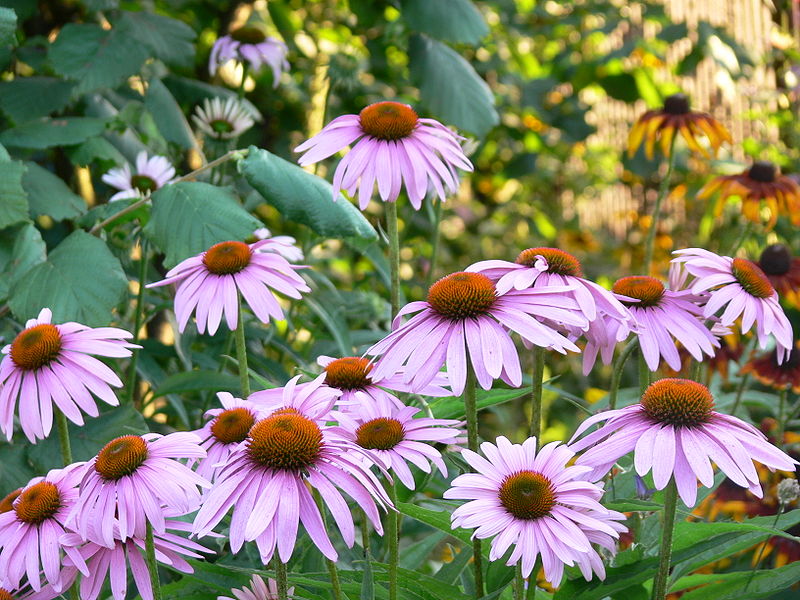
Echinacea |
| LATIN NAME:
Echinacea angustifolia, Echinacea
purpurea |
AKA: Purple
coneflower, black root, Kansas
snakeroot, Black Sampson,
Indian Comb |
| |
|
BACK TO
HERBAL WIKI INDEX |
|
| Echinacea
angustifolia, Wikipedia |
|
|
|
|
Common Name: Echinacea
|
Echinacea purpurea
L.; Echinacea
angustifolia;
purple coneflower, black root, Kansas snakeroot,
Black Sampson, Indian Comb
|
|
Family
|
Asteraceae
|
|
Part Used
|
E. angustifolia :
Root used by early herbalist, still most
commonly used;
E. purpurea;
aerial parts or roots 2-3 years old. Roots
collected fall or very early spring; Shoots and
flowers-harvest at beginning of flowering.
|
|
Active constituents
|
Alkamides, caffeic acid
derivatives or phenylpropanoids,
polysaccharides, glycoproteins, Flavonoids,
|
|
Actions
|
Alternative,
immunostimulant, antimicrobial,
anti-inflammatory, local anesthetic, vulnerary,
carminative, tonic, anticatarrhal, antipyretic,
anticancer;
TCM actions:
1. Clear Retained Pathogen, tonify and regulate
Defensive Qi; 2. clear Wind Heat, 3. Clear Lung
heat, clear Lung Phlegm heat, 4. Clear Heat
Toxin, 5. Clear Bladder Damp Heat; 6.treats St.
Qi stagnation, stimulate digestion and relieves
abdominal fullness
|
|
Indications
|
Recurring respiratory infection, especially in
weakened individuals for short term prevention,
early stage infection, and early stage
post-infection recovery; acute respiratory
infections, allergic rhinitis, acute bronchitis,
pleurisy or pneumonia; septicemia, gangrene,
boils, abscesses, leucorrhea; acute or recurring
urinary infections; acute or chronic bacterial
or viral infections; stomatitis, painful skin,
ear and wound infections, snakebites, and
ulcerated tumors, enhance wound healing, vaginal
candidiasis, and fungal infections; cancer
protective effects, relieves pain of erysipelas,
and cancerous growths; improves feed efficiency
in pigs; Strangles in horses, canine distemper,
Omphalophlebitis, and
beneficial for saddle sores, “slow forms’ of
cerebrospinal meningitis
|
|
Cautions
|
Use ONLY from
sustainable sources
|
|
Contraindications
|
Allergies to plants in
the Daisy family ; possible if auto-immune
disease (not proven);
|
|
Herb Drug
Interactions
|
Possible interaction
with any drug that in involved with the CY3A4
Enzymes ; Possibly can counteract immune
suppressant drugs
|
|
Dosage (use animal doses
where available, otherwise human doses can be
included here but specify)
|
Humans: Dried herb:
3-10 g TID (can increase by 6X):
Fresh plant juice:
6-10 ml daily;
Infusions:
5-30 g per cup with 1 cup TID, up to every 2
hours;
Tincture:
1:2-1:3-0.5-1.5 ml per10 kg. divided daily
Specific guide
E. angustifolia
dried root: 1–3 g/day.
E. purpurea
dried root: 1.5–4.5 g/day.
E. purpurea
dried aerial parts: 2.5–6.0 g/day.
E. purpurea
expressed juice of fresh plant: 6–9 mL/day.
E. pallida
ethanolic extract of
root: 2–4 mL/day.
Small Animal: Dried
herb: 25-300
mg/kg divided daily;
Infusion:
5-30 g per cup. ¼-1/2 cup per 10 kg. divided,
Tincture:
1:2-1:3-0.5-1.5 ml per 10 kg divided daily
Large Animal:
fluid extract
1:1: 2-15 ml
|
|
| |
|
Notes: Promoted by
Dr. Meyers in Meyer’s Blood Purifier, this consisted of
Echinacea, Wormwood and Hops.
Temperature: cool;
Taste: acrid, bitter, slightly sweet (diffusive,
stimulating)
Tissue State:
depression, irritation
Native American use:
treatment for snakebite, colic, infection and wounds;
topically as an analgesic for toothache, sore throat,
cough, GI distress and venereal disease and skin
lesions.
Fyfe: Wherever
disease results from lack of vital force, from a
tendency to morbific changes, from a depraved state of
the fluids, from blood-poisoning, or from a tendency
toward disintegration of tissue, Echinacea should always
constitute at least a part of the treatment.
King’s: useful for
abscess, furuncles, cellulite, swelling from snake or
insect bites, septicemia from many sources, fever,
ulcerative stomatitis, for pain from cancerous growths
as well as for internal use for mammary cancer and
cancer cachexia. The specific indication: tongue coated
black, putrescent odor from excess of broken-down
material being eliminated from the system, as in scarlet
fever, diphtheria, spinal meningitis and typhoid fever,
strumous diathesis; old sores and wounds; snake bites
and bites of rabid dogs; tendency to boils and
carbuncles; foul discharges from weakness and
emaciation; deepened, bluish or purplish coloration of
the skin. Professor Webster: “action in slow forms of
cerebrospinal meningitis, he asserts that as a stimulant
to the capillary circulation no remedy is comparable
with it.”
Matthew Wood: It
has a wide range of applications to heat conditions,
both those arising from tissue depression and those
associated with allergy and excitation. It is a
stimulate that has a cooling taste and effect. It is
also sweet, indicated as a nutritive. It is suited to
pathological conditions which manifests as an edematous,
doughy condition of the muscular tissue, and under
palpation, gives to the touch a sensation like that
where there is deeply burrowed pus. It is suited to
cases where white cell production is required in high
amounts to combat putrefactive conditions or where
health has been compromised due to a ling-term septic
drain on the system. It is suited to a high level of
exhaustion, overwork, and long hours; when a person gets
sick when they have a chance to relax.
Specific indications:
tongue coated with dirty brown or black; ulcerative
pharyngitis, tonsillitis, and stomatitis, fatigue from
overwork, swollen blue veins, and lymphatics,
septicemia, septic infections, boils, abscesses, eczema
from blood toxins, deepened, bluish, coloration of the
skin with a low form of inflammation, old sores,
gangrene, bee stings.
Peter Holmes: The
remedy is very valuable because it stimulates capillary
circulation and peripheral nerves, thereby restoring
function and tone to pale, lifeless tissues, reducing
mucosal over secretion and promoting tissue
detoxification.
Recent research:
Macrophage activation has been well
demonstrated, as has stimulation of phagocytosis;The
activation of polymorphonuclear leucocytes and natural
killer (NK) cells and increased numbers of T-cell and
B-cell leucocytes have been reported ;
stimulates and
chemokine production) and stimulates NO production in
vitro; partially inhibit both COX-1 and COX-2 isoenzymes
thus decreasing prostaglandin E2 levels; Ethanol
extracts from echinacea roots showed potent agonist
activity on TRPV1, a mammalian pain receptor. The
compounds involved in the TRPV1 receptor activation
differed from those involved in the inhibition of
prostaglandin E2 production ; exert a mild anaesthetic
activity, which is typically experienced as a tingling
sensation on the tongue; reduces the incidence of tumour
development; E. purpurea was able to show
radioprotection (use before radiation) as well as
radio-recovery effectiveness; can stimulate mammary
epithelial cell differentiation); activity against
gastrointestinal nematodes in goats and pigs; may be
effective in reducing chemotherapy-induced leucopenia
|
| |
| |
| |
|
|