 |
| Veterinary Botanical
Medicine Association |
| Dedicated to Developing
Responsible Herbal Practice |
| |
| MEMBER WEBSITE |
| |
|
Jasmine C. Lyon,
Executive Director |
|
QUESTIONS?
email
office@vbma.org |
| |
| Established in 2002 by
Susan Wynn, DVM, RH(AHG) |
|
|
|
| |
|
|
| |
|
VBMA Herbal Wiki |
 |
| COMMON NAME:
Hawthorn |
| LATIN NAME:
Crataegus monogyna |
| AKA:
Mayblossom, Maythorn, Quickthorn,
Motherdie, Haw |
| |
|
BACK TO
HERBAL WIKI INDEX |
|
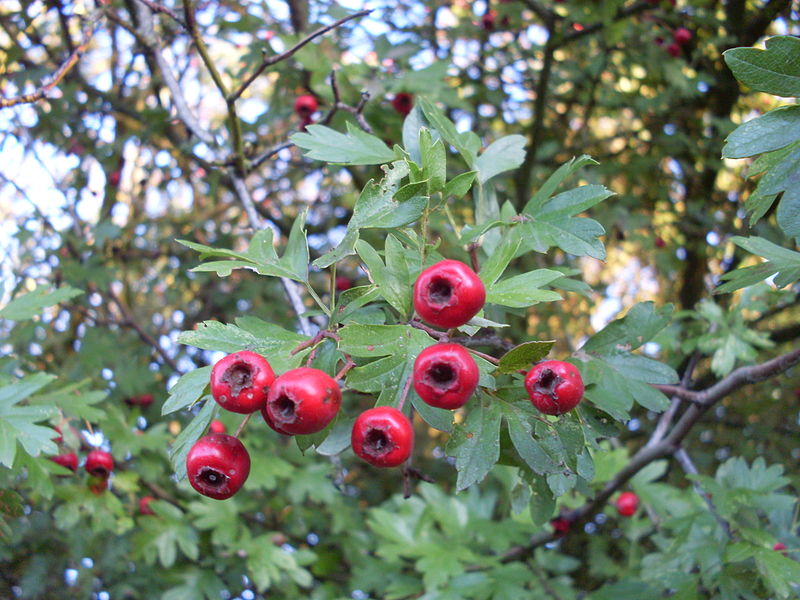
| Crataegus monogyna,
Elstro, Wikipedia |
|
|
|
Hawthorn, *Crataegus monogyna*,
is a thorny shrub or small tree with fragrant white or
pinkish flowers with a blood red small fruit. This tree
is native to Europe, Northwest Africa and Western Asia.
Medicinally the dried fruit, leaves and flowers are
used. Traditional Chinese Medicine, with a sweet and
sour taste, it had been used to promote digestion and
move food stagnation.
The current cardiac use of Crataegus started in 1896
when *Dr. Jennings* of Chicago reported the successful
use of Crataegus in various forms of heart disease. He
said with a case load of 275 patients atha, Crataegus
oxyacantha is superior to any other of the well known
and tried remedies at present in use in the the
treatment of heart disease, because it seems to * CURE*
while the okther remedies are only palliative at best.
He also realized that Crataegus's astringent effect
that Culpeper wrote about also can be "equally
efficacious in dropsies not of cardiac origin and used
with greatest of success in albuminuria and in diabetes
mellitus and insipidus. The flavonoid rutin is believed
to act on the capillaries, reducing wear and tear-thus
increasing the passage of blood and removing congestion
associated with heat. |
| |
Energetics:
sour, sweet, slightly warm; berry; The flower and leaf
are slightly sweet and bitter and astringent.
Meridians: Heart; Liver; Spleen, St.
Actions: *Jeremy Ross:*
1. Tonify Hear Qi-cardiotonic and antiarrhythmic- used
to treat cardiac weakness with exhaustion and debility;
could be associated with depression
2. Stabilise and firm the Heart Qi-can treat Heart Qi
irregularity or Heart Spirit scattered- can treat
cardiac arrhythmias, palpitation, insomnia, energy
fluctuations, emotional fluctuations; also tonifies the
yin, clears deficiency heat, relaxes the heart and
nerves
3. Clear Heart Phlegm-cardioprotective, antilipidemic,
antiatheromatic, antihypertensive; treates heart fluid
congestion: cardiac edema, high blood lipids, hard
deposits
4. Move Heart Blood-cardioprotective, antianginal
5. Promote digestion, removes accumulations and relieves
distension-treats food stagnation |
| |
| CULPEPER |
| The seeds in the berries are
good against the stone and the dropsy; the distilled
water of the flower stayeth the lask (diarrhoea). The
seed..is good for inward tormenting pains. If cloths
and sponges be wet in the distilled water, and applied
to any place wherein thorns and splinters, or the like,
do abide in the flesh, it will notably draw them forth.
And thus you see the thorn gives a medicine for its own
pricking, and so doth almost everything else. |
| |
| ELLINGTON |
| *Ellington* (after Jennings'
work) said that Crataegus may be regarded as specific in
the following cardiac disease: Angina pectoris, valvular
deficiency, with or without enlargement, endo-myo and
pericarditis, tachycardia, rheumatism of the heart,
cardiac neuralgias from whatever cause, palpitation,
vertigo, apoplexy, dropsy and functional derangement.
...It is a true heart tonic and restorative and capable
of exercising an immediate soothing and strengthening
influence upon that organ thereby improving the
circulation, and augmenting oxygenation of the blood.
Used in heart weakness with valvular murmurs, great
difficulty in breathing, persistent sighing respiration
which accompanies neurasthenia of nervous weakness,
brought on in young people from violent overstrainor
prolonged extreme nervous tension. It has a general
curative effect upon the functional action of the
central nervous system; upon every part of the
circulation apparatus; upon the urinary organs, and the
processes of metabolism. It depels gloomy forebodings,
increases the strength, regulates the action of the
heart, The doctor is sure he has seen excellent
results from Crataegus in the treatment of diabetes
insipidus, especially in children; also in exopthalmic
goitre with good results |
| |
| WOOD |
| *Matt Wood* says: Hawthorn has
been shown to lower unhealthy cholesterol and high blood
pressure. It decreases the irritability of the
capillaries, so that the blood passes more quickly and
efficiently, thus reducing congestion and heat. He
feels, in people, a specific indication for Hawthorn, is
if the meaty parts of the palm are red and if these
fatty tissues are depressed with a finger and is
followed by blanching, then the indication is that
there is heat and irritation in the capillaries with
friction between the walls of the vessels and the RBCs
so that the blood cannot flow though as quickly.
Hawthorn also has an affinity for the coronary
circulation, and a tonifying effect on the large
vessels. By reducing heat, Crataegus lessens
restlessness, irritability, anxiety, and nervousness
that sometimes accompany cardiac conditions. It has
been cited as a remedy for Attentions deficit by David
Winston. By relaxing the nervous system and heart,
irregular pulse and arrhythmias are overcome. Hawthorn
has been cited as a remedy for autoimmune disease. It
reduces irritation of the skin, mucous and blood
vessels. It also reduces irritation and redness of the
skin and increases the ability of the skin to form a
healthy scab. Hawthorn has been traditionally used to
help with the digestion of lipids, being used for
sluggish digestion especially of meat. In Europe it was
customary to use hawthorn berries with meat to make it
more digestible. |
| |
| WEISS |
| *Rudolf Weiss* feels that it
opens the coronary arteries and improves blood flow to
the heart. It opens the coronary arteries and improves
blood flow to the heart strengthening the myocardium. Crataegus
improves the nutrition, activity, energy reserves, and
energy release of the heart muscle. So, it has a
beneficial effect in degenerative, age-related changes
in structure. It is useful in cardiac arrhythmias. |
| |
| HOLMES |
| Hawthorn berry is called a
heart trophorestorative, and such should be used in all
organic heart disorders. It also has functional
restoring and stimulating actions on the heart and on
coronary and arterial circulation. The net result is
regulating effect on the whole cardiovascular system.
Because the heart's energetic role as a central organ
is to balance metabolic with neurosensorial function,
balance is promotes throughout the whole system.
Hawthorn has been found to improve deficiency and
depository conditions which affect the heart. |
| |
|
|