|
Notes: Perennial
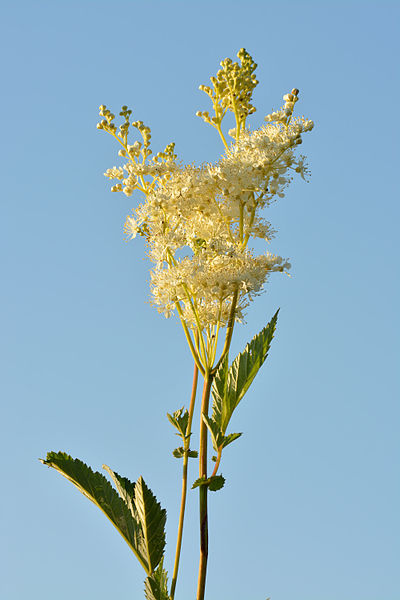
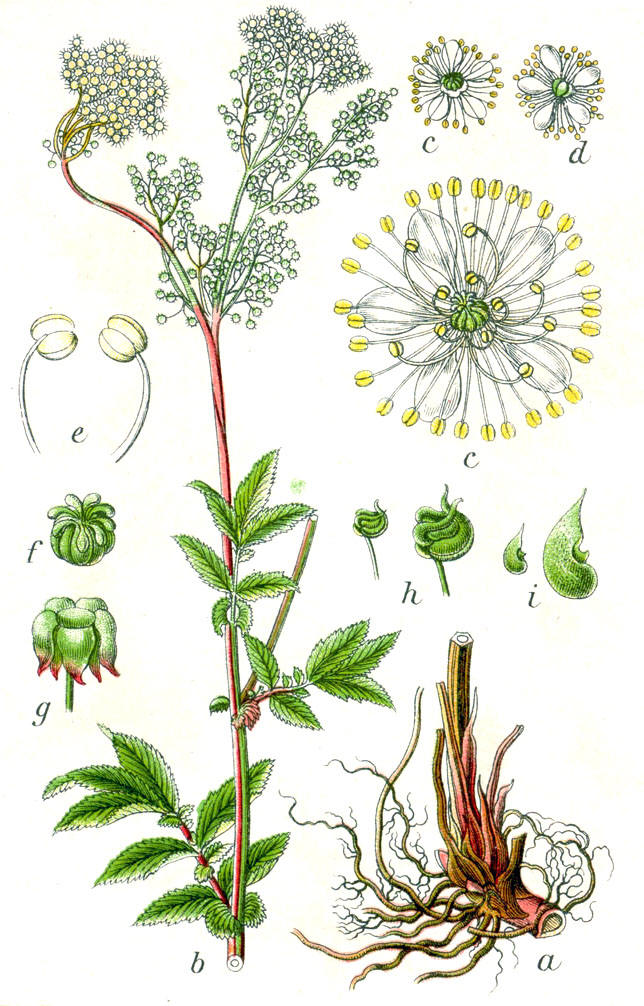
herb grows up to 1.5 meter tall with erect, furrowed
reddish to purple stems. Leaves are dark green on the
tip; whitish and downy underneath; loves to grow in damp
area which is in the Rose family. It was native to
Europe and western Asia, now naturalized in North
America. Some of the older authors refer to this under
the Latin name of Spirea. note the name a-spir-in)
Temperature: cool
(contains flavonol glycosides which are cooling)
Taste-
sour-astringent, bitter
Meridians- St, Bl,
intestines
Captain Fran Roberts,
says, "Meadowsweet is a true normalizer of a badly
functioning stomach. It regulates acidity and it
rectifies alkalinity. Also made into a strong tea is
highly beneficial in all cases of fever...It will be
found to not only relieve but eventually cure all cases
of sour belching, sour eructations, nausea, sickness,
and vomiting after meals or vomiting before meals..."
Richard Hool, "The
value of meadowsweet in the treatment of gravelly
affections depends more upon its alterative than upon
its diuretic influences...more effective in the removal
of uric acid deposits than of other calculous
formations...highly beneficial in all cases of rheumatic
fever...by means of its anti-acid and astringent
properties, it removes uric acid deposits from the
blood, muscles, and joints; expels waste, morbid, and
diseased particles of matter from the body...it drives
away the fever restores the action of the liver, kidney,
and bladder; renews and tones up the power of all the
digestive organs by bringing them back to their normal
condition; restores the appetite, strengthens the nerves
and muscles.."
Tissue state when
indicated: excitation or relaxation (Matt Wood)
Specific indications: headache with indigestion; full
feeling in the stomach with nausea, mucus in the
stomach, lack of appetite, irritation, acidity of
stomach with abuse of antacids; peptic ulcer, diarrhea
in young ; acute catarrhal cystitis; influenza with ache
in the points; arthritic pain in extremities
Bastyr said
specific indication was atonic dyspepsia with heartburn
and hyperacidity.
Peter Holmes says
that Meadowsweet's high silica and silicic acid content
helps to reinforce surfaces such as connective and
epithelial tissue and helps the treat messy wounds and
mucosal inflammations.
Culpeper; "It is
used to stay all manner of bleedings, fluxes, vomitings..it
is said to alter and take away the fits of the quartan
agues and to make a merry heart..It soon relieves the
colic, it openeth the bowels...outwardly applied it
healeth old ulcers that are cancerous, hollow, and
fistulous, and for sores in the mouth, or secret parts."
Cook writes about
Spirea tomentosa (not ulmaria) but common name is
Hardhack, meadow sweet, or Steeple Bush which the root
is used as a tonic and astringent and used in sub-acute
and chronic diarrhea when the assimilative organs are at
fault.
De Bairacli Levy:
spring tonic for animals; used to treat fever, blood
disorders, diarrhea and dropsy; strong infusion to
control hemorrhage from deep wounds, with leaves and
glowers administered externally and internally; use
internally for eczema, heat rash, scurf and heat spots.
Research: I t
appears that the effect may involve a prostaglandin
(PG)-mediated mechanism.
Hepatoprotective: An in vivo trial has
demonstrated the hepatoprotective and antioxidant
effects of meadowsweet; (Shilova etal 2006). Meadowsweet
extract (70% ethanol, 100 mg/kg) was shown to improve
liver function in carbon tetrachloride (CCL4)-induced
hepatitis in rats. In many parameters, the extract was
shown to be more effective than Carsil, a silymarin
preparation well known for its hepatoprotective ability;
antiadhesive activity against C. jejuni;
anti-Helicobacter and anti-Campylobacter effects
|