|
Notes: Dusty
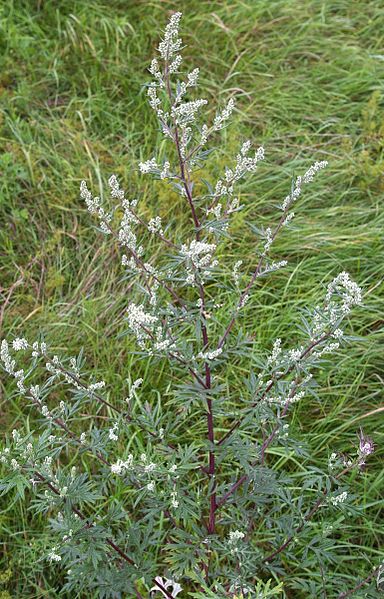
looking perennial of the lowland grown, in Europe and
eastern North America
Energetics:
pungent, and bitter, cool and dry; restoring, relaxing,
stimulating, and decongesting
Meridians: Liver,
Bladder, Chong and Ren
Cunningham: Cleanse
negative influences, but in addition it is protective
and enhances psychic abilities. Traditionally leaves are
gathered on midsummer’s eve, root gathered in Autumn..
Hung over the entrance to a house to guard against
misfortune, if hidden under the doorway, ensures
protection against unwanted visitors. It Aids
clairvoyance and infusion are drunk as a tea before
divination. Fresh leaves can be rubbed on crystal balls
or scrying mirrors, and dried leaves can be used as
incense when divining. A pillow stuffed with mugwort
leaves will help to stimulate prophetic dreams.
Hildegard von Bingen
says that Mugwort is very hot and its juice is of very
great value. If it is cooked and eaten as a puree, it
heals ailing intestines and warms a cold stomach. But if
someone eats or drink something which has given him
pain, then he should cook and eat warmed mugwort with
meat or lard, or as a purée. It will attract the rotten
matter which was in the previously ingested food or
drink and chase it away. If bad humors gather in some
part of the body, flowing out from broken skin where
there is no poisoned wound, the person should take
mugwort and express the juice. He should spread this on
the afflicted area, then cover it with an egg white and
tie it with a cloth.
Culpeper: This is
an herb of Venus…good success put among other herbs that
are boiled for women to sit over to draw down their
courses, to help the delivery of their birth; as also
for the obstructions and inflammations of the mother. It
breaketh the stone, and causeth one to make water where
it is stopped. The juice thereof made up with myrrh, and
put under as a pessary, worketh the same effects, and so
do the roots. Being made with hog’s lard into an
ointment, it taketh away wens and hard knots, and
kernels in the neck and throat, and easeth the pains
about the neck. It is a special remedy upon the overmuch
taking of opium. Three drachms of the powder of the
dried leaves taken in wine, is a speedy and certain help
for sciatica. A decoction made with camomile and
Agrimony, and the place bathe while it is warm, taketh
away pains of the sinews and cramp.
Peter Holmes:
Mugwort root was traditional European remedy for
epilepsy. Do not confuse with California mugwort,
Artemisia heterophylla which was used by Native
Americans for colic, diarrhea, fevers, headache, and
rheumatism; external poultices to stop haemorrhage, and
relieve, red, sore eyes and poison ivy rashes. The
Chinese herb Artemisia, Ai Ye is also a different
species, Artemisia argyi; its emphasis is on
stopping uterine bleeding rather that promoting menses
and also has antiasthmatic, antitussive, expectorant and
antiallergic properties. According to Chen and Chen; Ai
Ye is the main ingredient compressed into Moxa sticks.
When burned, the heat penetrates into the muscles,
tendons and bones to activate qi and blood circulation
and warms peripheral channels and collaterals.
From Native
American Medicinal Plants: Karok- used as analgesic
infusion for afterbirth pains; poultice used for colds;
Kiowas-worm medicine; Miwok: analgesic-leaves
worn is nostrils for headaches; decoction for
rheumatism; Paiute-used as a cold remedy; topical
for gonorrhoeal sores; used topically for back-ache;
Pomo used heated leaves on newborn’s navel;
Tlianit-used in steam bath for pleurisy
Grieve:
Mugwort abounds on hedgebanks and
waysides in most parts of England. It is a tall-growing
plant, the stems, which are angular and often of a
purplish hue, frequently rising 3 feet or more in
height. The leaves are smooth and of a dark green tint
on the upper surface, but covered with a dense cottony
down beneath; they are once or twice pinnately lobed,
the segments being lanceshaped and pointed. The flowers
are in small oval heads with cottony involucres and are
arranged in long, terminal panicles; they are either
reddish or pale yellow. The Mugwort is closely allied to
the Cornmon Wormwood, but may be readily distinguished
by the leaves being white. The Mugwort is said to have
derived its name from having been used to flavour
drinks. It was, in common with other herbs, such as
Ground Ivy, used to a great extent for flavouring beer
before the introduction of hops. For this purpose, the
plant was gathered when in flower and dried, the fresh
herb being considered unsuitable for this object: malt
liquor was then boiled with it so as to form a strong
decoction, and the liquid thus prepared was added to the
beer. Until recent years, it was still used in some
parts of the country to flavour the table beer brewed by
cottagers.
It has also been suggested that the name, Mugwort, may
be derived not from 'mug,' the drinking vessel, but from
moughte (a moth or maggot), because from the days
of Dioscorides, the plant has been regarded, in common
with Wormwood, as useful in keeping off the attacks of
moths.
In the
Middle Ages, the plant was known as
Cingulum Sancti Johannis,
it being believed that John the Baptist wore a girdle of
it in the wilderness. There were many superstitions
connected with it: it was believed to preserve the
wayfarer from fatigue, sunstroke, wild beasts and evil
spirits generally: a crown made from its sprays was worn
on St. John's Eve to gain security from evil possession,
and in Holland and Germany one of its names is St.
John's Plant, because of the belief, that if gathered on
St. John's Eve it gave protection against diseases and
misfortunes.
Dr. John Hill
extols its virtues, and says:
'Providence
has placed it everywhere about our doors; so that reason
and authority, as well as the notice of our senses,
point it out for use: but chemistry has banished natural
medicines.'
Dioscorides
praises this herb, and orders the flowering tops to be
used just before they bloom.
The dried leaves were, sixty or seventy years ago, in
use by the working classes in Cornwall as one of the
substitutes for tea, at a time when tea cost 7s.
per lb., and on the Continent Mugwort is occasionally
employed as an aromatic culinary herb, being one of the
green herbs with which geese are often stuffed during
roasting.
The downy leaves have been used in the preparation of
Moxas,
which the Japanese use to cure rheumatism. The down is
separated by heating the leaves and afterwards rubbing
them between the hands until the cottony fibres alone
remain, these are then made up into small cones or
cylinders for use.
Artemisia Moxa and
A. sinensis
are mainly used in Japan. This cottony substance has
also been used as a substitute for tinder.
Sheep are said to
enjoy the herbage of the Mugwort, and also the roots.
The plant may, perhaps, be the Artemesia of Pontos,
which was celebrated among the ancients for fattening
these animals. It is said to be good for poultry and
turkeys.
Matthew Wood:
It is a restorative when there has been obstetric
injury, abortion, abuse, poverty, deprivation. It is as
if the male part has rushed ahead to protect the injured
female part. Mugwort is restorative to the injured
female nature. In European Phytotherapy, it is
considered to stimulate secretion of FSH and LH. It is
indicated in insufficiency of the corpus luteum from
anemia. It is a remedy for excessive androgneism. In (MW’s
experience) excess androgen tends to bring on conditions
of chill and fever. “It is as if cold were struck in the
system and the heat is trying to drive it out, resulting
in chill/fever, or “Intermittent fever”. The muscles are
weak and malnourished, subject to bouts of cold,
soreness, pain, and spasm. In Chinese Herbalism, the
leaves of mugwort are rolled to moxa sticks and burned
to increase warmth and circulation. Tissue state of
depression, constriction and atrophy
Specific
pulse- weak pulse on the right and stronger on the left.
In Japan mugwort is pounded into glutinous rice to make
gomogi mochi
a food that provides stamina and is
traditionally given to new mothers to stop postpartum
bleeding and anemia, and to promote lactation.
Dorothy Hall: suited to highly intelligent people
with complex thoughts that are difficult to describe,
speech disorders and dyslexia, highly elevated senses,
sensitivity to light and sounds, with great difficulty
getting to deep sleep
|