|
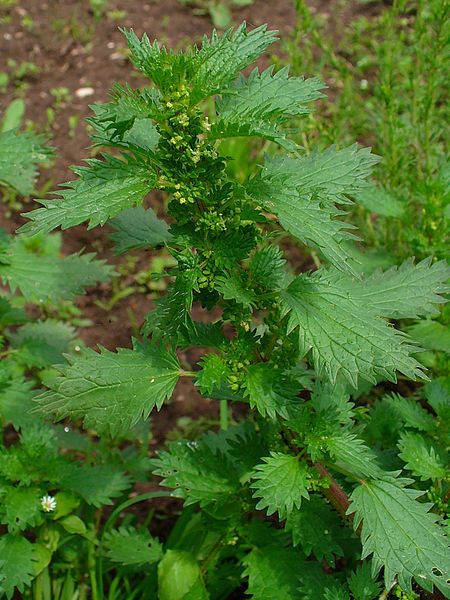
Notes: Nettles, Urtica
urens, is a perennial herb. Leaves are opposite with the
characteristic stinging bristles. Urtica has an almost
worldwide distribution, grows on a widely varied
habitat, and especially likes waste ground.
Energetics: sweet;
cool-warm; taste: acrid, Leaf: Temperature:
warm-cool
Taste- acrid
Organ : Lu, Bl,
Intestines;
Affinities:
Genitourinary, blood, skin, and eyes.
The seed, leaf and root
are all used and all three have slightly different uses.
Culpeper says,
“..Nettles is an herb Mars claims dominion over. You
know Mars is hot and dry, and you know as well that
Winter is cold and moist, then you may well know as well
the reason why Nettle tops eaten in the Spring consume
the phlegmatic superfluities in the body of man, the
coldness and moistness of Winter hathe left behind.”
Peter Holmes likes
a juice of the entire Nettle plant; for lung conditions
combined with Mullein flower, Elecampane root, Coltsfoot
herb.
Hair rinse for weak and
falling out hair: a vinegar decoction of Nettle root
Classified as a mild herb
with no known contraindications (ESCOP), drug
interactions or adverse effects if overdosed. An
occasional individual many of slight allergic reaction
but only if susceptible.
Leaf versus Root- (Jeremy
Ross); Both can be used to treat urinary disorders
Root is especially linked
to the treatment of early stage benign prostate
hyperplasia and the urinary symptoms associated with it,
whether irritative or obstructive.
Peter Holmes says,
“Nettle herb’s detoxicant, digestive, urinary and
glandular actions provide excellent support for complex
metabolic disorders especially when they involve
connective tissue. As working on the blood level, Nettle
herb is a medium strength hemostatic and astringent for
hemorrhages.” Leaf is used to treat respiratory,
intestinal, skin and joint disorders, whilst Urtica root
does not have a main tradition of use for these
problems.
One of Steve Marsden’s
lectures; “Nettle leaf has great anti-histamine
proprieties and to be helpful in any pruritic case.”
David Winston-(From
2012 AHVMA conference)- " Nettle leaf is widely renowned
as a nutritive pot herb, diuretic, antiarthritic, and
antihistamine, along with many other uses. Nettle seed
is also a skin herb, it's specific indication being skin
that looks or feels like paper and tears and bleeds
easily. It can be combined with Horsetail and Gotu Kola
to enhance its activity. Nettle root is widely used in
Europe but is still relatively little known in the U.S.
as an antidyscratic agent, especially for the prostate.
Nettle root in combination with Saw Palmetto,
Collinsonia and White Sage is a highly effective formula
for treating BPH symptoms. Nettle seed is perhaps the
most profound medicine from this versatile herb. The
seed is the most effective kidney tropho-restorative
that I have used. Alone or combined with Cordyceps,
processed Rehmannia, Cornus Fruit, Rhubarb root and Dang
Shen Root, I have found it helpful for slowing the
progression and even moderately reversing degenerative
kidney disease, including glomerulonephritis, and
chronic nephritis with degeneration."
Matt Wood-.".is one
of the fundamental remedies of traditional Western
Herbalism. .Nettle acts on the protein pathways in the
body. It reduces allergic reactions to proteins; and
eliminates mucus on membranes resulting from allergy;
also helps with the digestion and absorption of protein.
It helps the liver build blood proteins. These help keep
the plasma inside the blood vessels, reducing edema and
low blood pressure resulting from loss of plasma into
the tissues. Nettle also helps with the removal of
proteinaceous waste products from the system, hence it
is a remedy in gout, arthritis, muscular soreness,
tissue acidity, and kidney disease. It also has a
specific action as a tropho-restorative bringing back
function to parts that have become paralyzed, atrophied
or functionally inactive. It also works internally on
inactive kidneys, thyroid, menstruation, hormones,
nerves, muscles to bring them back into effective
operation."
He considers the taste to
be sweet, bitter, earthen and stimulating and useful to
treat tissue states of depression, atrophy and
stagnation.
Specific indications: low
blood pressure, loss of hair and hair color, mental
dullness, lack of concentration and mental acuity;
diarrhea, dysentery, chronic, mucus in stools, inactive
kidneys (seeds), chronic inflammation of the bladder
with abundant mucus discharge; benign prostatic
hypertrophy (root), menstruation: excessive, anemia from
blood loss, atrophy and paralysis of muscles,
hypothyroid; all bites that itch.
Felter: in The Eclectic
Materia Medica, Pharmacology, and Therapeutics "A
Specific Medicine is effective in stubborn eczema of the
face and scalp. Internal-profuse choleric and excessive
mucous discharge, as in cholera infantum and dysentery,
are reputed to have been controlled by urtica, while it
also has a restraining effect in gastric secretion, and
eructations and vomiting. Chronic cystitis, with large
mucous diuresis, is also asserted to have been benefited
by it
Cook in the
"Physio-Medical Dispensatory"-The root is a strong
astringent, with moderately stimulating and tonic
qualities, of a sharp taste. As a local arrestor of
bleeding, it has few equals; and its infusion is of much
power, used inwardly, for bleeding form the nose, lung,
or stomach, and may also be used to excellent advantage
in bleeding from the bowels and passive menorrhagia.
Some have used it in diarrhea; but it is suitable only
for low conditions and chronic forms of that malady. It
is said to act well upon the kidneys.
Ellington-Urtica
has been employed for the general purposes of an
astringent, both internally and externally, in
hemorrhages, ill-conditioned ulcers and in chronic
disease of the mucous membranes of the bronchi, bowels
and urinary organs, and it is generally agreed to be an
efficient remedy. It appears to have a dynamic action as
in post-partum hemorrhage, suppression of the milk in
nursing women, retrocedent eruptions, urticaria,
jaundice, dropsy, ague and corpulency its influence in
small doses is reliable. The fresh leaves have been used
as a powerful revulsive in lethargy, paralysis,
intoxication, congestion of the brain, and hysterical
insensibility. This agent is also used when there is
excessive mucous discharge form the bowels. Persistent
watery diarrheas are controlled by it.
Culpeper-"..it is a
safe and sure medicine to open the pipes and passages of
the lungs, and helps to expectorate tough phlegm..the
juice is effective to settle the palate of the mouth,
and to heal and temper inflammation and soreness of the
mouth and throat...It also provokes the urine and expels
gravel and stone in the reins or bladder...the juice of
the leaves stays bleeding at the mouth. The seed is a
remedy against the stinging of venomous creatures and
(protects) against the poisonous qualities of hemlock,
henbane, nightshade, mandrake, or other such like
herbs...The seeds or leaves bruised put into the
nostrils, stays the bleeding of them, and takes away the
flesh growing (Hm..anyone try this for proud flesh in
horses??). The juice of the leaves, is good to wash old,
rotten, or stinking sores or fistulous, and gangrenes."
Greg Tilford:
Specific Uses:
All of species of
Urtica
cause an instantaneous contact
dermatitis that is characterized by tiny blisters and a
burning sting.
Although gloves
and a long sleeved shirt must be worn when gathering the
greens, complete drying or cooking neutralizes the
plants’ antigenic proteins and formic acid
compounds; the constituents responsible for the plants’
sting. These compounds break down quickly when
exposed to air and/or heat, and when correctly prepared,
the leafy greens of young nettle plants are delicious
and contain a vast array of vitamins, minerals and
nutrients.
This makes
nettle an excellent addition to food for animals
which need extra trace minerals and vitamins in their
diet, but not necessarily in huge, multi-vitamin doses.
This applies to animals which are already on a natural
diet, or those who are sensitive to excessive vitamin or
mineral supplementation because of chronic digestive
disorders, existing systemic toxicity, or urinary
tract problems. The
completely
dried herb can be sprinkled directly
onto the animals’ food, 1/2 tsp. for each pound of food
fed, or 1/3 tsp. per meal for cats. Herbivores can
be fed the dried greens in their usual diet, and many
will relish it as a special treat. In Sweden and
Russia, where the problems of producing nutrient rich
feeds is compounded by a very short growing season,
winter-hardy nettles are sometimes cultivated, and later
dried, as fodder crops.
For finicky pets
that despise anything but what their humans are eating ,
try cooking the fresh young plants, with enough water to
cover, until they are entirely soft and tender.
The cooked greens are excellent with butter.
Nettle is
also a good alternative for the more endangered
Eyebright
(Euphrasia
species) as a primary anti-inflammatory agent for the
eyes.
Many
herbalists who suffer from seasonal allergies have found
that nettle leaf helps lessen their symptoms if taken on
a regular basis in tincture or tea form, starting before
hay fever season. In a recent study involving 69
patients who suffer from allergic rhinitis, 58% found
relief after taking a freeze-dried preparation of the
leaf2.
Alternatives and
Adjuncts: For
anti-inflammatory eye and skin washes, alternatives
include raspberry leaf, chamomile, dandelion, calendula,
or oxeye daisy. For conjunctivitis which is
secondary to bacterial or fungal infection, nettle
combines well with a small part of Oregon grape.
Nutritive adjuncts include spirulina, flax seed, red
clover and alfalfa. For allergies, nettle combines
well with elecampane, coltsfoot, goldenrod, lobelia, or
licorice as lesser adjuncts. For urinary
incontinence and inflammations of the urinary tract,
look at couchgrass, corn silk, cleavers, uva-ursi,
goldenrod, and marshmallow.
Cautions &
Comments:
Touching the live plant will result in a painful,
blistering sting. Use this plant before it
flowers— mature plants contain gritty particles that can
irritate the kidneys.
|