 |
| Veterinary Botanical
Medicine Association |
| Dedicated to Developing
Responsible Herbal Practice |
| |
| MEMBER WEBSITE |
| |
|
Jasmine C. Lyon,
Executive Director |
| QUESTIONS?
email
office@vbma.org |
| |
| Established in 2002 by
Susan Wynn, DVM, RH(AHG) |
|
|
|
| |
|
|
| |
|
VBMA Herbal Wiki |
 |
|
|
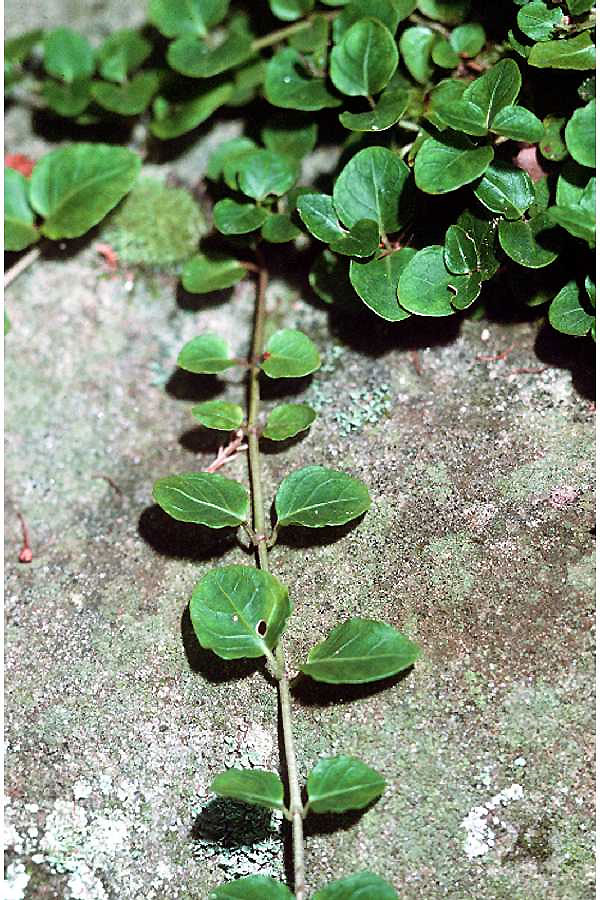
Mitchella repens |
|
|
|
| TRADITIONAL USES: |
| American Indians: used as a remedy
for a wide range of female reproductive problems
including cramps, delayed or irregular menes, heavy
menstrual flow, labor difficulties, and infertility.
Leaf infusion and poultice were used to soothe sore
nipples, hemorrhoids, and wounds. |
| |
| FOLK USES: |
| Herbal steam to relieve pain and a
decoction of the berries in milk to stop diarrhea and
treat dysentery. |
| |
| CURRENT USES: |
| Important gynaecological remedy
reliable tonic to treat deficiency and weakness with
symptoms such as infertility, lack of menses, menstrual
pain, and threatened miscarriage. reduces excessive
heavy menstrual flow and relieving persistent vagina. |
| |
|
Taste: slightly sweet
treats an atrophied tissue state
Specific indication:
female: leucorrhea, prolapse of the uterus,
menstrual irregularity, swelling and pain,
congestion of ovaries and uterus, infertility, birth
defect preventative, preparation of labor; treats
postpartum depression
|
| |
| ELLINGWOOD |
| "Therapy- the sphere of action of
mitchella is upon the reproductive organs, particularly
upon those of the female. It is par excellence the
partus preparator. Not only can all complicating
influence be removed, but the nervous system can be so
influenced that that parturition to the mother can be
shorn of dead and terrors, and can be looked forward to
without anxiety or fear...Erratic pains and unsatisfied
longings are removed, the nervous system assumes a
tranquil condition, reflex symptoms abate, the urinary
function is improved and the appetite becomes natural.
Labor approaches, devoid of the irritating, aggravating
complication, the preparatory stage is simple, the
dilatation is completed quick, the expulsive
contractions are strong, nonirritating, and effectual
and are much less painful that without the remedy;
involution is rapid and perfect, there are no
subsequent, complicating conditions to contend with, the
patient;s strength is not abated, and the function of
lactation is in its best condition...The bark of the
fresh root in hot infusion given occasionally during the
progress of labor when no previous care of the patient
has been afforded the physician, will work wonders in
some tedious aggravating cases. In uterine disorders at
other times this agent is most effectual remedy. It
overcomes painful menstruation, regulates the function
relieves congestion in the pelvic organs and soothes
general irritation of the nervous system from uterine or
ovarian cases...it has been used to prevent abortion." |
| |
| COOK |
| "This article is mildly stimulating
and slightly relaxing exerting its influence rather
slowly but persistently and leaving a gently but
desirable tonic impression upon the frame. The greater
portion of its power is expended upon the uterus, where
its action is tonic and moderately antispasmodic;but it
also influences the kidneys, testes and the entire
nervous system as connected with the generative organs.
The chief value set upon it by most physicians is for
its soothing and strengthening influence upon the uterus
in hysteria, leucorrhea,prolapsus, and rheumatic or
neuralgic pains, and chronic painful menstruation. Its
action in all these connections is of the most
beneficial character; at the same time that it steadily
maintains a fair secretion of urine, and relieves aching
of the back....its influence upon other portions of the
system has almost been overlooked. For all forms of
nervous feebleness and irritability of a chronic
character, it is an excellent agent; and it exerts a
highly favourable influence over spermatorhea. On the
mucous membranes it exerts a mild tonic influence, which
slowly abates excessive mucous discharges, but this
action is wholly tonic. and may be used for catarrhal
and leucorrheal discharges, as will as for chronic
dysentery." |
| |
|
|