 |
| Veterinary Botanical
Medicine Association |
| Dedicated to Developing
Responsible Herbal Practice |
| |
| MEMBER WEBSITE |
| |
|
Jasmine C. Lyon,
Executive Director |
|
QUESTIONS?
email
office@vbma.org |
| |
| Established in 2002 by
Susan Wynn, DVM, RH(AHG) |
|
|
|
| |
|
|
| |
|
VBMA Herbal Wiki |
 |
| COMMON NAME:
Passion flower |
| LATIN NAME:
Passiflora incarnata |
| AKA:
Maypop, Purple Passion Flower, Wild
Apricot |
| |
|
BACK TO
HERBAL WIKI INDEX |
|
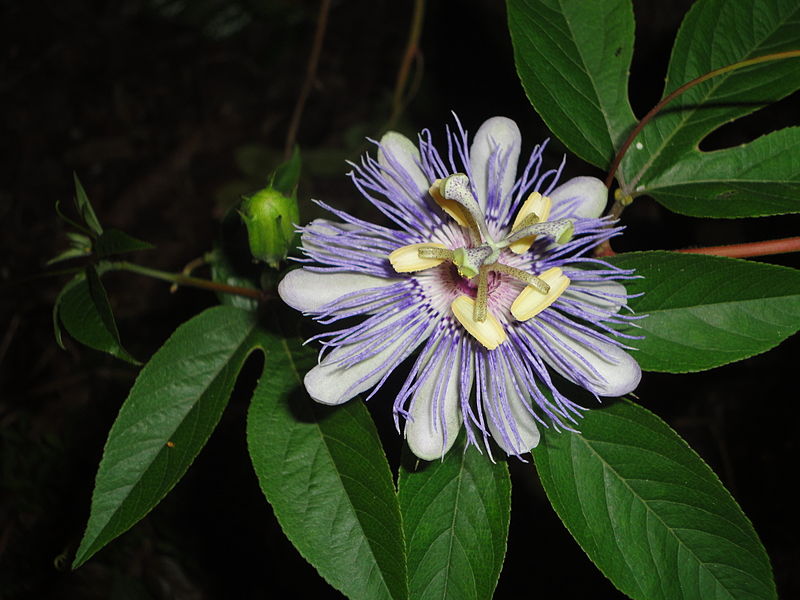
| Passiflora
Incarnata, photo by
E. Nielsen, Wikipedia |
|
|
|
Passion Flower,
Passiflora incarnata,
is native to SE United Sates. It likes to grow on
roadsides and field edges, on sunny, moist ground.
It is fast growing, a perennial climbing vine. The
flower is unbelievably beautiful. When we were in
Spain, Julio, our herbal teacher, said that when he
first saw a Passion Flower, he could not believe it
was real.
In 1650 this was a newly discovered plant and
was sent to Pope Paul V from a Jesuit mission in
Peru, saying the flowerhead represented the
Passion of Christ.
Energetics: neutral-cool
Taste: slightly bitter,
slightly sour and sweet
Organs:
Ht, Liver, Kidney
Actions: (Matt Wood
and Jeremy Ross)
1. Calm Heart Spirit- tranquilizer and
nervine to treat insomnia, restlessness,
mild to moderate anxiety, overexcitement
treats heart Yin deficiency
2. Calm Kidney fear-fearfulness, especially
in children; treat kidney qi
constraint-chronic burn-out, agitated
depression
3. Calm Liver Yang-head congestion,
headache, muscle tension, sleep loss
4. Circulates lung qi, opens the chest and
relieves wheezing and coughing; reduces lung
and qi constraint.
No known contraindications, no reports of
adverse effects in pregnancy, compatible
with breastfeeding, no reported adverse
effects, no drug interactions known; only a
very very rare hypersensitivity possible.
Flavonoids are the main constituents.
In Europe and North America, the aerial
parts of Passion Flower are used. In
Brazil, the leaves of P. edulis are used
and have a wider range of us
|
| |
| HOLMES |
| Peter Holmes classifies it as a
medium strength herb, it can cause, in children under
four, overexcitment, if given a large dose. He says
that through its sympathetic nervous inhibitant action
and bitter, cool energetic qualities the remedy
specifically prevents the Body's yang from floating to
the surface relieving tight muscles, congestive
headaches, sleep disorders, and nourishes heat Yin,
relieving anxiety and palpitations. These are the
energetic origins of the remedy's specific
muscle-relaxant, cerebral decongestant and analgesic
action. |
| |
| WOOD |
Treats the tissue states of irritation and
constriction with Specific indications of nervous
excitement with muscular twitching; evidence of
approaching convulsions in children-with marked
cerebral fullness; wakefulness, sleeplessness,
mental chatter, inability to turn off the internal
dialogue; easily distracted and overstimulated
during the day; can't fall asleep at night.;
Chatterboxes; pain in head with red tipped tongue;
asthma and spasmodic cough; hiccoughs and pain in
the stomach that comes on and hour after eating in
females; pelvic engorgement.
This remedy acts on the nerve centers
controlling respiration and blood pressure, so
it is suited to conditions where there is
spasmodic cough and temporary high blood
pressure induced by overstimulation, tension and
stress. It has been used in whooping cough and
nervous asthma. It also settles digestive
irritation related to nervous stimulation and
tension; hiccough, vomiting and indigestion.
|
| |
| ROSS |
| Jeremy Ross feels, "a mild
traquilizer, spasmolytic, and analgesic; it may take a
few days of continued intake for it to have an effect;
specific for children (He uses Anemone if Passion Flower
is ineffective); a nervine tranquilizer, that can slowly
strengthen the nervous system, especially in cases of
exhaustion and debility; calming without the heavy
dulling effect on the mind and body that Valeriana or
Piscidia can sometime produce." |
| |
| HOWELL |
|
Patricia Kyritsi Howell advises Cherokees collected
passion Flower roots and either pound them to make a
poultice or infused them for tea. The Poultice was
used to draw out inflammation from boils or skin
infections caused by brier scratches. The infusion
was used to soothe weaning babies. Drops of warm
infusion were used to treat earaches. Passionflower
fruits or maypops, were crushed and the juice was
thickened with cornmeal or flour to make a pleasant
beverage drink. Shoots and young leaves were cooked
and eaten as wild green. Modern herbal practice,
passionflower leaf and flower are important nervine
relaxants with a wide range of uses. A reliable
acute remedy to relive tension headaches and relax
tight muscles. it is also used to treat insomnia,
anxiety, and restlessness. Useful when excessive
tension results in chest constriction, breathing
difficulties or heart palpitations. Passion Flower
may be effective in relieving vascular constriction
that contributes to high blood pressure. The pulp
collected from inside ripe fruit is made into jelly
or syrup.
Harvesting: Collect leaves and flowers when in
bloom during June and July. Gather maypop
fruits after they turn pale green or yellow in
September and October. Yellow passion Flower is
rare and should NOT be harvested.
|
| |
| FYFE |
"Passiflora relieves irritation of the nerve centers
and improves sympathetic innervation. As a result
of this action a beneficial influence is exerted
upon the circulation and nutrition. It has been
extensively employed in various forms of
convulsions, and usually with satisfactory
results. In dysmenorrhea it exerts a relieving
influence, and in neuralgia it has often proved
useful. Passion Flower has also been highly
recommended in tetanus and the severest spasms of
children...It is not toxic, and has also been
administered to the very sick and weak without any
harmful action.
From failures we have, we believe that it does
not do well when the tongue is dirty, heavily
coated. But when given to a patient, young or
old, with a clean tongue, it acts promptly and
pleasantly...it is excellent remedy to be used
with gelsemium. It greatly augments its
action. In the sleeplessness of typhoid, when
the tongue is clear, passiflora has acted
decisively and promptly. In the sleepless,
cholera infantum infected infant, and in the
neurasthenic who has become so from overwork or
abuse of the nervous system, as well as the
wakeful old man or woman, passiflora is the
remedy. It is a nervine, antispasmodic and
sedative.
Indications-Delirium, especially that
characterised by low muttering, sleeplessness
following the excessive use of alcoholic
stimulants; fretfulness of teething children;
pelvic engorgement attended with severs pain;
pain in the stomach which comes on an hour or
two after taking food; pain the the head, with a
sensation of great weight pressing upon the
brain; pains in the abdomen and pelvis peculiar
to pregnant women; cholera infantum, when there
are great restlessness and spasmodic conditions;
distressing insomnia caused by cardiac
disturbance."
|
| |
| ELLINGWOOD |
|
"..the physiological action of passifloa
incanata..the agent exercises a depressing influence
upon the reflex activity of the spinal cord. In
acute mania it arrests the exaggerated activity of
the cortex, It temporarily reduces the pulse and
arterial tension, the latter apparently being due to
an action upon the vasomotor center of the medulla
oblongata. It stimulates the respiration and can
therefore be given in large doses without danger.
..it is used in an application of the bruised leaves
as a poultice to the head , for headaches; also to
bruises to relieve pain. spcific
sypmtomatology-wakefulness, disturbed sleep from
mental worry, and exhaustion from cerebral fullness
and from excitement, especially with feebleness.
Anaemic patients are relieved by it, also the
wakefulness of infants and the aged. It is not
efficient if the wakefulness is caused by pain.
Therapy- In convulsions of childhood it is most
reliable agent. It has controlled severe spasms
while the irritating cause yet remained, It can
be relied upon to hold the spasms in check while
the causes are being removed, and reduces their
force and character. In epilepsy it lessens the
number of the paroxysms, but to ward off the
paroxysms the attack must be anticipated by a
full dose of the remedy. Passiflora has
hypnotic properties which differ from other
agents of this class in that the sleep produced
is normal in all its characteristics. The
patient goes t o sleep naturally, can be
awakened as usual at any time, to fall into a
quiet, natural slumber...He awakens at the usual
time rested and refreshed, with no disturbance
of the cerebral function, no languor, dullness
or other disagreeable sensations. If given in
doses sufficiently large, it may be relied upon
to assist in the relaxation of the tonic spasm
of meningitis and local tetanic spasm. It has
relieved a few cases of general tetanus. It has
cured tetanus in horses. It may be given as an
antidote to the spasms of strychnine
poisoning,........As an anti-spasmodic in cases
where there is engorgement of the nerve centers,
it is applicable. It has relieved tonic and
clonic spasms, and the spasms of stenic as well
as asthenic conditions. In the treatment of
hysteria the agent should be persisted in. Dr.
Roth believes that passiflora is a direct
stomach sedative. (great relieve for
hiccoughs). Passiflora had his reliance in the
sleeplessness of tuberculosis, especially
controlling the cough. Other forms of cough can
be relieved by it. the agent is not known to
possess injurious or poisonous properties. It
has been used in erysipelas both externally and
internally, and in inflammatory skin disorders
with nervous elements and nervous complications.
|
| |
| FELTER |
|
"Specific indication-Irritation of brain and nervous
system, with atony; insomnia from worry or
overwork;, or from febrile excitement; sleeplessness
in the young and aged; convulsive movements;
hysteria; infantile, nervous irritability; dyspnoea;
palpitations of the heart from excitement or shock.
Passiflora is used chiefly in spasmodic
affections and as a rest-producing agent. It is
one of the best agents we possess to allay
restlessness and overcome wakefulness, when the
result of exhaustion, with cerebral fullness, or
due to the nervous excitement of debility...It
is admirable adapted to young children and old
persons to promote rest and sleep, and it acts
similarly when sleeplessness is caused by worry,
overwork-physical and mental-or due to the
exhaustion of fevers."
|
| |
| SCUDDER |
| Also used Passion lower for
liver congestion accompanied by hemorrhoids and used the
remedy to congestive ovarian and uterine conditions. |
| |
| |
|
|