|
| Veterinary Botanical
Medicine Association |
| Dedicated to Developing
Responsible Herbal Practice |
| |
| MEMBER WEBSITE |
| |
|
Jasmine C. Lyon,
Executive Director |
|
QUESTIONS?
email
office@vbma.org |
| |
| Established in 2002 by
Susan Wynn, DVM, RH(AHG) |
|
|
|
| |
|
|
| |
|
VBMA Herbal Wiki |
|
|
|
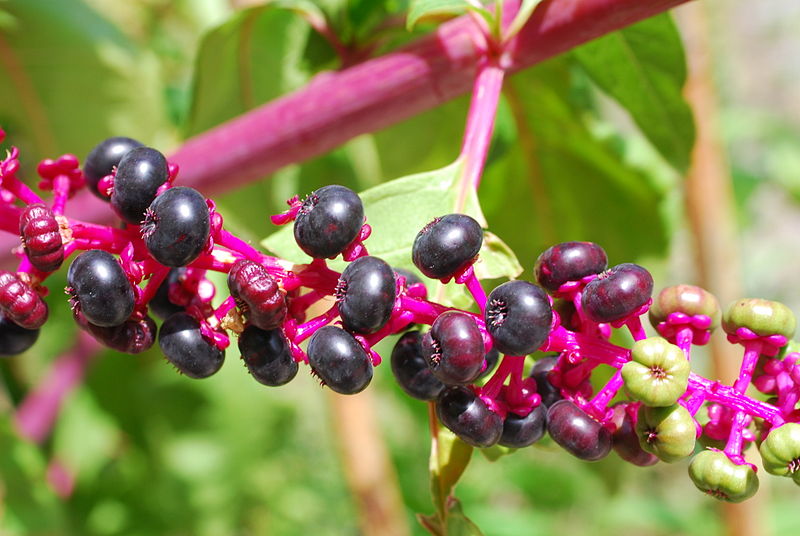
Pokeroot, Phytolacca decandra.
This is a native American Plant that traditionally was
used by the Indians and pioneers as a spring tonic and
green. (The leaves must be boiled twice with the water
thrown away to decrease toxicity.) It is a tall shrubby
perennial with stems that become red as the plant
matures.
Taste: pungent, bitter
Temperature: cool
Organs: Lungs and channels to skin,
muscles and tissues
Tissue
states: torpor, depression
Action
1. clear Lung Phlegm, and
retained pathogens with an antimicrobial,
anti-inflammatory, alterative, anticatarrhal- treats
recurring respiratory inflammations with lingering
catarrh,
2. Clear Heat Toxin and retained
pathogen-antimicrobial; tonsillitis,
3. Move Qi, Clear Damp,
and Phlegm-lipomas, prostatic enlargement
4. Clear Damp Heat, reduces lymph congestion,
relieves eczema, and reduces tumors, reduces liver
congestion- treats Liver Qi stagnation with damp
heat
|
| |
| HALL |
|
Dorothy Hall considered
Phytolacca to be the number one endocrine regulator. It
enhances the environment through which hormones have to
travel. It has an especially strong influence on the
pituitary and thyroid, but also on the adrenals and sex
glands. |
| |
| WOOD |
|
Matt Wood says of Poke Root that it is as profoundly
acting as it is toxic with a special affinity for the
glandular system; especially when there is stagnant,
swollen lymphatics, swollen sore throat, diphtheria,
mastitis with a powerful regulation on the endocrine
system. There are symptoms of toxic blood and blood
stagnation (red and purple coloration and purple
eruptions) with nervous symptoms such as shooting pains.
Specific Indications: Large bulky
persons with large glands, big breasts; teenagers in
puberty after glandular growth with lack of personal
delicacy; disregard of surrounding objects; indifferent
to life; sense of apathy and indifference, lives in a
pigsty. lazy teenagers, soreness of mouth, sore throat,
with tendency to death of epithelium, swollen throat;
pain worse on sticking out the tongue; pain at the root
of the tongue; diphtheritic deposits, fullness bout the
throat; breast affections; mastitis, swollen breasts,
sharp shooting pains from the nipple, mammary abscesses;
Arthritis; especially when the endocrine system is out
of order; aches and pains in muscles and joints; Skin
symptoms due to ancestral taint; difficult to treat;
slow recoveries; disease of the skin or blood, with
death of and imperfect reproduction of the epithelium.
(He uses dried root; tincture, use a small does three
drops, once a day in chronic affections, hourly in acute
fever. The less toxic berries are used for wight loss
and rheumatoid arthritis; three berries a week.) |
| |
| HOLMES |
|
Pete Holmes uses Poke leaves taken in a strong
decoction or suppository for a treatment
of hemorrhoids and chronic constipation. A
thickened juice of the leaves was traditionally used
as a folk remedy for skin cancers and chronic
indolent ulcers.
Cautions: Preparations from the
dried root may be used safely if therapeutic dose in
not exceeded. Contraindicated in pregnancy and
lactation. Dose duration is recommended to be less
that 6 months. Poke root is emetic and purgative in
large doses. Peter Holmes adds that dosages must be
respected, adds forbidden during pregnancy.
|
| |
| ELLINGWOOD |
|
he most direct action of the
agent is inflammation of glandular structures,
especially of the lymphatic glands. Pains of a
rheumatic character for deficient catabolism are
relieved by it. It is directly indicated in irritation,
inflammation and ulceration of mucous membranes in
rheumatic subjects, sanious ulcers, scabies, tinea
capitis, sycosis, psoriasis, favus, noli ne tangere
and all skin diseases. The agent must now have especial
attention in its influence in the treatment of acute
inflammations of the throat. (any type; from simple to
diphtheria). Dr. J.V. Stevens is enthusiastic in his
opinion that adenitis needs no other remedy. Too much
cannot be said of its very positive and invariable
influence in the treatment of acute inflammations of the
breast during or preceding lactation. ...adding this
remedy to alternative compounds...for those prescribed
for children's glandular and skin disorders. ..It
should be used in the treatment of syphilitic disorders
resulting in ulceration..In varicose and other
long-standing ulcer, in psoriasis, dermal abscesses,
fissures, boils, carbuncles. |
| |
| WACA |
| Dr. Waka uses phytolacca and
echinacea in the treatment of any form of albuminuria.
Its action in relieving irritation, inflammation and
ulceration of mucous membranes in all parts of the body
suggests it as a remedy in inflammations of the lining
membrane of the heart. The presence in the blood of an
infectious irritant, which causes rheumatic pains, as in
sciatic rheumatism and irritation of the mucous
membranes, or inflammation of the throat associated with
rheumatic pains, and enlargement and ulceration of
lymphatic glands from scrofula or syphilis, is an
indication for the remedial action of phytolacca. |
| |
| FYFE |
| Fyfe wrote: Phytolacca occupies
a place peculiarly its own. In the treatment of
diseases of the glandular system this fact is many times
markedly apparent. Its curative effect is so promptly
manifested in inflammations and ulcerations of the
mucous membranes of the various parts of the body that
there can be no doubt its energetic power. In
inflammation of the breasts, will prevent the formation
of abscesses. In tonsillitis and the sore throat of
scarlet fever, it has no superior. In wrongs of the
liver, especially when there is enlargement and
induration, or a torpid condition of the organ, the
patient should be given the aid afforded by this
efficient medicament. ..decided merit in gonorrhoea and
leucorrhea and in syphilis, especially of the tertiary
form. It is also a remedial agent of great usefulness
in the large number of chronic conditions is which the
secreting , absorbing and eliminating vessels have
become impaired. It is one of our most efficient drugs
in the chronic form of articular rheumatism. Phytolacca
decandra is alterative, diuretic, laxative, resolvent,
antiscorbutic and antisyphilitic. In large doses it is
emetic, cathartic and narcotic. Indications-Enlargement,
inflammation or pain in glands; mucous surface of the
fauces full and of dark color, the tonsils swollen,
throat dry or covered with patches of tenacious
secretion or ash-colored exudation; depressed function
or imperfect secretion; fatty degeneration of the heart.
Locally: Threatened abscesses in glands. |
| |
| SCUDDER |
| "The tincture of the fresh root
(note most today only use the dry root and feel some
toxicity in fresh root) is one of my favorite remedies.
It exerts a direct influence upon the processes of waste
and nutrition, and therefore possesses those properties
called alterative in a high degree. I have used it in
secondary syphilis, in chronic skin disease and in
scrofula with excellent results. it has a direct
influence upon the mammary glands, and will generally
arrest inflammation is given in the early stage.I also
employ it in cases of sore nipples, both internally and
locally, with good results. It is one of the most
certain remedies we have in diphtheria. It is a most
valuable remedy in sore mouth, either in children or
adult..even the nursing sore mouth is frequently cured
by it. It is a prominent remedy in parotitis and in its
metastasis to the testes. |
| |
| BLOYER |
| Bloyer adds that "its
stimulating action upon the glandular system makes it an
excellent remedy in orchitis." |
| |
| CHRISTOPHER |
|
Christopher in 1976 also used Phytolacca to treat
obesity and as an adjunct for syphilis and cancer
treatment. |
| |
| BHP |
| BHP in 1983 also added as an
ointment for scabies, tinea, sycosis and acne and as a
poultice for mammary abscesses and mastitis. |
| |
| COOK |
| Cook has a different view on
the part used: the young leaves are used as "greens" in
the spring, and are the best articles for that purpose.
The young roots provoke very persistent vomiting. The
older and dried roots retain the same acro-narcotic
properties and this part of the plant is rejected from
Physio-Medical practice. The berries of this plant are
relaxant, with a peculiar and not very unpleasant taste,
and a slow action. Their chief power is expended on the
glandular structures, mildly but persistently securing
better flow of saliva, urine, and perspiration, and
freer action of the bowels. They make a valuable agent
in scrofulous maladies, especially those connected with
a chaffy skin and costiveness. In chronic and sub-acute
rheumatism, few agents exert so peculiar and so valuable
a power. Those forms of rheumatism which attack the
synovial and ligamentous membranes, the muscular
sheaths, and other serous tissues, seem to be most
benefited by their use. The berries are not poisonous,
and may be used in sub-acute cases quite as well as in
chronic ones. The best method of employing them, is to
crush the ripe berries, and add thirty percent alcohol
to preserve the mass. One pint of rectified whisky may
be added to each pint of the crushed berries. The dose
may range from one to two ounces three times a day. |
| |
| FELTER |
| Felter used the dried root and
fruit: . Specific Indications-Pallid mucous tissue with
ulceration; sore mouth, with small blisters on buccal
mucous surfaces and tongue; sore lips, pallid and with
separated epidermis; fauces full and mucous surfaces
pallid, sometimes livid, with swollen tonsils and
whitish or ashen-gray tenacious exudate; aphthae;
imperfect glandular secretion; faucial, tonsillar or
pharyngeal ulceration; secretions of mouth impart a
white glaze over mucous membranes and tongue; white
pultaceous sloughs at angles of mouth or lining the
cheeks; hard painful glandular enlargements; pallid sore
throat with cough and difficult respiration; mastitis;
orchitis; parotitis; soreness and swelling of mammary
glands; diptheroidal sore throat; and fatty
degeneration. |
| |
|
|