 |
| Veterinary Botanical
Medicine Association |
| Dedicated to Developing
Responsible Herbal Practice |
| |
| MEMBER WEBSITE |
| |
|
Jasmine C. Lyon,
Executive Director |
| QUESTIONS?
email
office@vbma.org |
| |
| Established in 2002 by
Susan Wynn, DVM, RH(AHG) |
|
|
|
| |
|
|
| |
|
VBMA Herbal Wiki |
 |
|
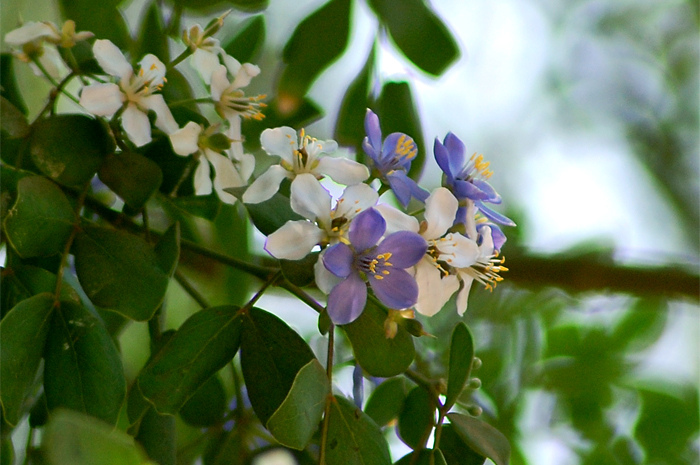
| Guaiacum officinale |
|
|
|
| Roughbark Lignum-vitae, Guaiacum
officinale, is a tree and the medicinal principle
is located in the gum form the wood, which is procured
by natural exudation |
| |
| SPECIFIC INDICATIONS: |
|
Specific indication according to Ellingwood is
Inflamed tonsils, swollen, tumid and painful.
Painful deglutitions. Dribbling of saliva.
Persistent dryness of the throat, with difficulty in
swallowing. Rheumatic difficulty, accompanying
tonsillitis. Rheumatic disease, accompanied
with any soreness of the throat. This is a
most active astringent in full doses and yet in
overdoses it acts as a cathartic. I n medium doses
it influences acute dysentery and diarrhea, and
other relaxed conditions of the bowels. In
very small doses, it is said to cure some cases of
habitual constipation those depending upon extreme
atonicity. It has on been used as a remedy for
chronic rheumatism. In rheumatic sore throat
and rheumatic pharyngitis it is a good remedy. The
indications for rhus toxicodendron will often be
found present with the indications for this agent.
Guaiacum had a reputation in the cure of syphilis.
It has alterative properties and is useful in some
cases of skin disease of a chronic nature.
|
| WOOD: |
| According to Matt Wood- "Guaiacum is
especially useful for persons suffering from cold, damp,
inactive extremities with arthritis or fibromyalgia.
When given warm or with warmth, it arouses a gentle,
outward circulation to the capillaries and opens the
pores of the skin; given cold it runs through the kidney
and influences the womb in chronic obstructive
conditions." |
| |
| COOK: |
| "The resin is an active stimulant,
quite local in action, exciting to the stomach and
slowly so to the remote circulation, and elevating all
the secretory organs by increasing their sensibility and
capillary flow. Such qualities at once interdict its use
in any case of irritated stomach or bowels, acute forms
of dyspepia, and febrile or inflammatory conditions. Nor
is it an agent that should be resorted to for sensitive
or plethoric persons, nor for those inclined to
pulmonary or uterine hemorrhage. It is best fitted for
phlegmatic and leuco-phlegmatic patients and for
maladies when the stomach is depressed and the general
activity of the system much reduced." |
| |
| THOMAS: |
| "acute tonsillitis and in amenorrhea
and dysmenorrhea when due to atony of the pelvic
viscera." |
| |
| FELTER: |
| "considerable vague as a remedy for
syphilis...The chief use for guaiac are in rheumatic
pharyngitis or rheumatic sore throat and incipient
tonsillitis with angry, red, raw-looking surfaces, where
the parts appear to be severely inflamed or greatly
congested. The latter may be the type with is the
forerunner of an attack of acute inflammatory
rheumatism. The tonsils being the foci of infection. It
is best adapted to passive condition's-cold hands and
feet, feeble circulation, and vital depression. In
general plethora or inflammation of the gastroenteric
tract it is usually contraindicated. It has been much
employed in chronic sore throat of syphilitic origin." |
| |
| |
|
|