 |
| Veterinary Botanical
Medicine Association |
| Dedicated to Developing
Responsible Herbal Practice |
| |
| MEMBER WEBSITE |
| |
|
Jasmine C. Lyon,
Executive Director |
|
QUESTIONS?
email
office@vbma.org |
| |
| Established in 2002 by
Susan Wynn, DVM, RH(AHG) |
|
|
|
| |
|
|
| |
|
VBMA Herbal Wiki |
 |
| COMMON NAME:
Saint John's Wort |
| LATIN NAME:
Hypericum perforatum |
| AKA:
Tipton's weed, Goatweed, Rosin Rose,
Chase-Devil |
| |
|
BACK TO
HERBAL WIKI INDEX |
|
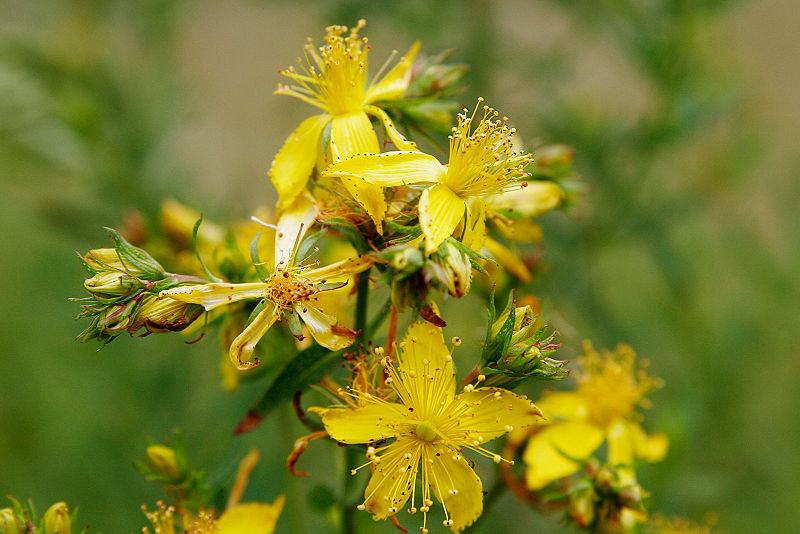
| Hypericum
perforatum,
fir0002, Wikipedia |
|
|
|
St. John's wort, Hypericum
perforaturm. This is a perennial up to 1 meter
tall with erect stems with a beautiful five petalled
flowers. The leaves have translucent dots in them. It
was native to Europe but was introduced into the
Americas. It likes to grow in grasslands, woods and
hedges.
Temperature: neutral
Tastes: sour-astringent,
bitter, slightly sweet
Organs affected: Ht, Kidney, Liver
Matt Wood describes the qualities
as "balsamic"; an oily plant with volatile oils that
are soothing, calming and curative. It builds
tissue tone, helps the liver process complex toxins,
and slightly strengthens the eliminative
faculties-skin, kidneys, colon, and lungs. it is
suited to weakness of digestive nerve refluxes and
the enteric brain, or animal instincts in the gut.
Action: (Jeremy Ross)
1. tonify and regulate the Heart and Kidney
Qi, calm Heart Spirit: nervine tonic;
antidepressant, anxiolytic; treats
depression with low mood, lack of interest,
tiredness, nervous excitability. Circulates
the qi; releases constraint and relieves
pain; restores the nerves and relieves
depression-treats kidney/adrenal Qi
constraint; can be useful in digestive-IBD
issues, neuritis, spinal pain especially in
the deep coccyx area, muscle tension
2. calm Kidney fear, regulate bladder
Qi-anxiolytic and astringent; circulates
bladder and uterus Qi, harmonizes urination
and relieves irritation and pain, promotes
urination, and can help to dissolve stones;
bed-wetting with a painful sacrum
3. heal wound-vulnerary; used topically for
laceration or puncture wounds and bruises;
treats injury with swelling and pain
including nerve injury, breast engorgement
and tumors; sores, ulcers varicose veins and
skin blemishes.
4.(Peter Holmes) Promotes
expectoration, resolves phlegm, and relieves
wheezing-lung phlegm damp with Qi constraint
5. clears Heat and Damp; reduces
inflammation and infection, stops discharge
and bleeding
St. John's wort has a history of magical
uses, Bartolomeus Carrichter
in 1673 wrote, "if a person be possessed of
an evil spirit, St john's wort leaves should
be given" St. John's wort is a gentle herb
well suited to children and the elderly.
Topically it has anti-inflammatory,
analgesic and vulnerary effects. It is one
of the best herbs for treating burns, ulcer
and wounds presenting with inflammation and
pain. It relieves nerve pain and neuritis.
It also has strong antiviral action. In
Chronic conditions, it is well fitting where
nervous deficiency lead to constrained Qi
with the presenting signs of nervous
tension, spasms, and depression. It is a
nervous trophorestorative and offers
relaxation with a long-term gradual
recuperation of energies and spirits. It
has been shown to have antidepressant
effects and can help to regulate sleep. It
is also a systemic relaxant that releases
tension and spasms both in smooth and
striped muscles. Its spasmolytic,
analgesic, and neuromuscular relaxant action
work on a diversity of conditions; with
exceptional effects on the bladder. It has
a strong tropism for the bladder and
addresses not only incontinence and
bedwetting fut also albuminuria and mucous
in the urine. So it treat damp cold in the
urogenital system when it tonifies the
Kidney Qi. St John's wort also has an
astringent effect on the capillaries of the
lower orifices.
Hypericum's main use for depression only
became widespread with in the last 25
years. It lightens the mood and can be used
for both anxiety and depression.
Traditional use in China-
Guan Ye Lian Qiao- neutral and
bitter; used to treat nosebleeds,
hemoptysis, intestinal bleeding,
external bleeding due to trauma.
Cautions:
photosensitivity if overdose.
Preparation: Pick the
flowers from midsummer onward. Can be
used as a infusion, tincture,oil or
salve
|
| |
| WOOD |
| It is best known as a first aid
remedy for injuries to nerves and is suited to injuries
to parts rich in nerves; eye, fingertips, spin, where
there are sharp, shooting pains, inflammation along
nerves, acute sensitivity and pain, blood poisoning from
injuries to fingers and toes, and clonic spasms and
convulsions from inflamed nerves. It is one of the most
important herbal pain-relievers. St. John's wort is
particularly called for in cases where the innervations
of the digestive tract, are weak and there is tension of
a toxic liver. It was an important psychiatric remedy
in the Middle Ages; its strengthens the enteric brain,
seat of the instincts thus drive away evil influences.
It treats tissues that are atrophied, constricted, and
depressed. Specific indications: anxiety, depression,
hysteria, insomnia, afraid of the dark. winter
depression, weakness of gut-instincts; concussed brain
or spine, meningitis, stiff neck, offensive breath with
gum disease; bleeding from lungs, whooping cough;
irritated but weak digestion; hemorrhoids, dysentery;
liver weakness, jaundice; stress emotions influence the
bladder, excessive urination, suppressed urine,
ulcerations of the urinary tract, pus in urine;
coccygeal pains, postpartum, swollen breasts;
inflammatory processes with acute pain, injuries to
parts rich in nerves with inflammation, convulsions,
spasm, redness needle-like pains; neuralgia, sciatica. |
| |
| BHP |
| Menopausal neurosis and
sciatica and neuralgia; this herb has a sedative action
and can be used for excitability. (night terrors in
children) |
| |
| ELLINGWOOD |
| Specific
Symptomatology-Muscular bruises, deep soreness, painful
parts. A sensation of throbbing in the body, without
fever. Burning pains, or deep soreness in the spine
upon pressure, spinal irritation, circumcised areas of
intense soreness over the spinal cork or ganglia.
Concussion, chock or injury to the spine, lacerated or
punctured wounds in any location, accompanied with great
pain. This agent by Homeopathic physicians in
considered specifically adapted to irritating, soreness
or chronic disease accompanied with tenderness of the
spinal column. It is used where there is shock or where
there are contusions or lacerations without shock. It
can prevent convulsions from spinal injury and can
prevent tetanus from puncture wounds, relieving the pain
resulting from injury. Used as a fomentation or ointment
it is applied to tumors, caked breasts, enlarged glands
, ecchymosis, bruises, swellings and painful ulcers |
| |
| FELTER |
| "Action and therapy: Internal-
Hypericum is said to be diuretic and sedative and as
such has been used in chronic urinary disorders,
particularly suppression of urine. It has a strong
influence upon the nervous system. It has a value in
nervous disorders. Useful in hysteria." |
| |
| FYFE |
| " Indications-nervous
depression accompanying painful wounds, and in the
nervous excitement following operation. Cases of
considerable usefulness in the treatment of spinal
irritation. catarrhal conditions of the urinary
passages; suppression of urine; chronic urinary
affections; nervous affection with oppression; passive
hemorrhages; contusions and laceration of the tissues;
diarrhea and dysentery. Locally in the forms of
ointments, liniments and diluted tinctures: tumors,
caked breasts, bruises and swellings; ulcers." |
| |
| RUSSIAN FOLK HERBALISM |
| It is considered to be a "liver
remedy" and a detoxifier. Alma Hutchins said to give
with Aloe powder and watch the urine, "whole flakes of
morbid matter are sometimes washed away." |
| |
| CULPEPER |
| "It is a singular wound herb;
boiled in wine and drunk, it healeth inward hurts or
bruises; made into an ointment, it opens obstructions,
dissolves swellings, and closes up the lips of wounds.If
drunk with the juice of knot grass, it prevents vomiting
and spitting of blood; it is good for bites or stings of
venomous creatures and for retention of water. ..gently
expels choler or congealed blood in the stomach. The
decoction of the leaves and seed drunk somewhat warm
before the fits of agues, alter the fits, and often
prevents them. The seed is much commended being drunk
for forty days for sciatica, falling sickness and
palsy." |
| |
| DIOSCORIDIES |
| "for sciatica and all aches of
the hips and used in the treatment of malaria." |
| |
| |
|
|