 |
| Veterinary Botanical
Medicine Association |
| Dedicated to Developing
Responsible Herbal Practice |
| |
| MEMBER WEBSITE |
| |
|
Jasmine C. Lyon,
Executive Director |
|
QUESTIONS?
email
office@vbma.org |
| |
| Established in 2002 by
Susan Wynn, DVM, RH(AHG) |
|
|
|
| |
|
|
| |
|
VBMA Herbal Wiki |
 |
|
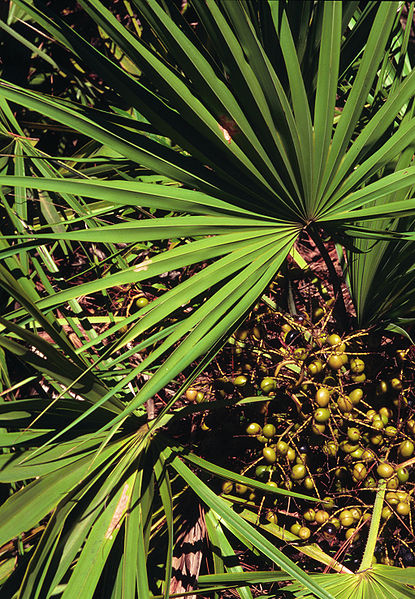
| Serenoa repens,
Wikipedia |
|
|
|
Common
Name: Saw Palmetto
Latin Name:
Serenoa repens (Serenoa serrulata; Sabal serrykata)*;
Sabal Fructus, sabal, sabal palm; Saw Palmetto
Family:
Arecaceae (Palmae)
Part Used:
Fruit; dried ripe or partially dried ripe
Active Constituents:
Fatty oil with fatty acids, steroidal saponins; esters,
phytosterols, and polysaccharides; carbohydrates,
mannitol; galactose; arabinose, uronic
acid; flavonoids
Actions: Urinary antiseptic,
diuretic, antihyperprostatic, nervine, tonic nutritive,
anti-inflammatory, anticatarrhal, spasmolytic,
anticancer; endocrine agent; adaptogen;
TCM:
1)Kidney yang deficiency;
2) Reduces swelling and inflammation;
3)Spleen qi deficiency with Liver Yin deficiency;
4) Lung phlegm cold and lung wind heat: promotes
expectoration, resolves phlegm and relieves
cough-reduces infections in throat; excellent
expectoratant;
5) regulate Qi of Kidney, Bladder, and Uterus; clear
Damp Heat and Phlegm; clear Damp Heat in Lower Burner |
| |
Indications:
Urination problems related to prostatic disease;
testicular atrophy; interstitial cystitis; spasmolytic
effect for pain of dysuria; acute and chronic catarrh,
asthma, pertussis, chronic laryngitis; functional
inactivity of the reproductive system; atrophy of
mammary, uterus or testes; feebleness of the urinary
organs; enuresis, incontinence, cystitis, urethritis,
orchitis, ovaritis, polycystic ovarian disease,
hirsutism, hyperandrogenism; lactation, infertility,
malnutrition, muscular wasting |
| |
Cautions:
None reported except if overdose some occasional minor
GI side effects
Contraindications: None known
Herb Drug Interactions: None
known |
| |
| Dosage (use
animal doses where available, otherwise human doses can
be included here but specify): *Human: Dried herb*: 3-10
g TID; *Liposterolic extract*: 320 mg; *Tincture:*1:2 or
1:3: 1-5 ml TID; Flu *id extract*: 10 drops to 2 drams.
*Small Animal: Dried Herb*: 25-400 mg/kg, divided;
*Tincture:* 1:2-1:3: 0.5-2.0 ml per 20 lbs. divided
Small scrub; with creeping horizontal, many-branched
stems. Fruit is a fleshy yellow-green drupe which
ripens to blue-black; Native to US from South Caroline
to Florida. |
| |
| Notes:
*Energy:* bit sweet, pungent, warm (neutral), dry:
(also considered soapy and moist); Western classified
as restoring, stimulating and astringent. David Winston
feels it should be classified as an adaptogen; Matt
Wood- nutritive tonic; sexual tonic and a sedative for
heat/excitation. Treats the tissue states of atrophy and
excitation *Meridians*: Kidney, Bladder, Liver, Spleen |
| |
| Felter:
Specific Indications: relaxation with copious catarral
secretions; lack of development or wasting of testicles,
ovaries, or mamae; prostatic irritation withpaonful
micturition, and dribbling of urine, especially in the
aged; tenderness in the lands and other parts of the
reproductive organs. |
| |
| Fyfe: From the
fact of its being a general tonic, saw palmetto may be
hopefully prescribed in any depraved condition. Its
special tonic and expectorant action on the respiratory
mucous membrane makes it a valuable remedy in phthisis,
in tuberculosis, laryngitis in acute and chronic
laryngitis, in bronchitis, in asthma, in whooping-cough,
and in cough generally when due to irritation of the
respiratory mucous membrane. It is also highly
recommended as a special remedy in catarrh-both in acute
and chronic. In these cases and inhalation of the
vapour of say palmetto is beneficial and not unpleasant. |
| |
| Ellington:
wrote that the "attention of the profession was called
to this palm by Goss and others, from its superior fat
producing properties in animals. It was observed as
soon as the berries matured that the animals which fed
upon them grew very sleek and fat. Read noticed the
healthfullness of the animals that fed upon them..Found
to improve digestion, increase the flesh, strength and
weight, and steadily relieve irritation of mucous
structures, especially those of the nose and air
passages...it is a tonic in stimulating the nutrition of
the nerve centres. Ellington talks a lot about Saw
Palmetto being a profound nutritive tonic. …increasing
the size and secreting power of the mammary gland...but
only indicated when they are abnormally small and
inactive. (so no artificial GnRH effect) "It may be
given with confidence in wasting of the testes in the
early stages and Ellington had retarded the development
of varicoceles in the testes…-"this agent is ascribed
considerable power in reducing the size of hypertrophied
prostate in old men, and in quickly relieving cystic and
other disorders incident to this condition. Also..BIG
HELP in correcting the irritable character of the urine,
increases the muscular power of the patient to expel the
urine and produce a sense of relief, that "is in every
way gratifying and satisfactory"!!!! Ellington said
that it is credited with cures in the treatment of
aphonia. |
| |
| Lyle:
excellent expectorant; it soothes the mucous membranes,
to treat the common cold, acute and chronic laryngitis
and bronchitis. |
| |
| Dr. Hale:
considered it to be one of the most effectual uterine
remedies. He found it to be the chief remedy in
metritis, pelvic cellulitis, peritonitis, salpingitis,
ovaritis, appendicitis, perityphlitis and proctits,
especially if the prostate gland is involved. So the
berry contains a steriod type chemical sistosterol that
seems to aid this Kd yang-Sp qi deficiency restoring
effect of the herb. (this compound seems to be what
inhibits the effects of dihydrotestosterone on the
prostate gland.) |
| |
| Peter Holmes:
recommends the combination of Saw Palmetto with Marigold
and Echinacea for inflammatory conditions of the
reproductive organs. *David Winston* combines Nettle
Root (Urtica dioica), Collinsonia (Collonsonia
canadensis) and White Sage (Salvia Apiana) in treating
Benign Hypertrophic Prostates. |
| |
| Matt Wood: It
improves nutrition and assimilation and rebuilds the
adrenocortical base, which calms down nervousness. By
decreasing atrophy and dryness it also decreases heat
and irritation. It has been known to increase the size
of breasts, testicles and reproductive organs when there
was malnutrition. However, its effect on the prostate is
to reduce swelling and irritation. It is part of the
Fountain of Youth in Florida! |
| |
| Jeremy Ross:
Serenoa appears to have a normalizing function,
enlarging urogenital organs b tonic action when
atrophied and reducing them by anti-inflammatory action
when pathologically enlarged. |
| |
| BPH: urinary
antiseptic and diuretic for cystitis; urogenital
catarrh, prostatic hypertrophy; anabolic agent and
endocrine agent for general debility, sex hormone
disorders, testicular atrophy *Recent Research*: There
is a great deal of research associated with prostatic
disease. The results suggest that SPE may have
potential application value for the prevention or
treatment of erectile dysfunction through an increase in
iNOS mRNA expression and inhibition of PDE5 activity in
corpus cavernosum smooth muscles. It has an inhibitory
effect on cell growth that is associated to the
down-regulation of inflammatory-related genes and to the
activation of NF-kappaB pathway in prostate
tissue.(anti-cancer effect) Serenoa repens could lead to
an improvement of androgenetic alopecia. This report
suggests that saw palmetto extracts selectively affect
the adipocyte differentiation |
| |
| |
| |
|
|