|
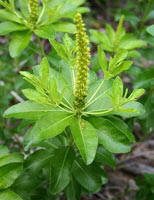
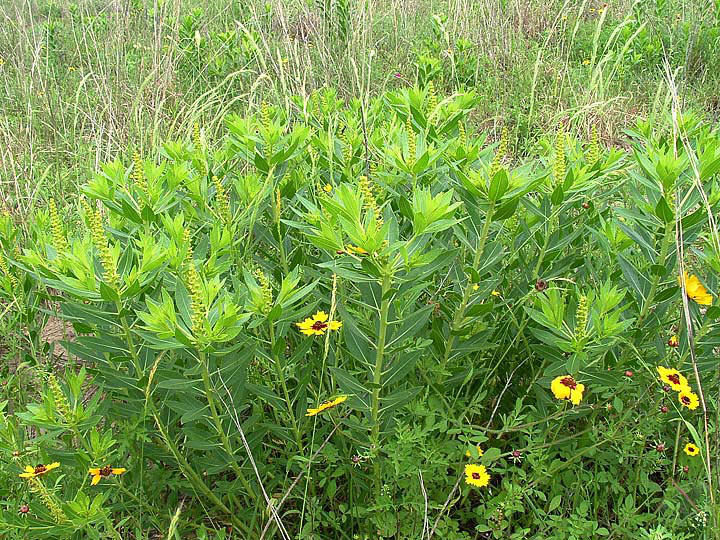
Native to the sandy coasts
of the South, from North Carolina to the Gulf of Mexico
Notes: due to loss
of habitat there is a current endangerment and scarcity
of this plant; Use only SUSTAINABLE SOURCES.
Energetic: bitter,
pungent, cool, dry; sweet and earthen; stimulating,
calming, softening; Meridians: Liver, Lung
Tissue States:
atrophy, torpor
David Winston:
Stillingia has a long history of use for syphilis and
chronic degenerative conditions Powerful alterative best
in small doses to stimulate liver, lymph, and kidney.
Indicated for croup, pertussis, and spasmodic or
irritated cough with MM tissue that is red, dry and
glistening.
Scudder: “increases
waste and excretion, but its principal action probably
is upon the lymphatic system, favouring the formation of
good lymph, hence good blood and nutrition; In cases of
chronic disease where the tissues are feeble and not
readily removed and renewed. It is an excellent remedy
in the treatment of some cases of chronic laryngitis,
speedily relieving the irritation and cough, and we
employ it is chronic bronchitis with like good results.”
Cook-“This root is
prominently and almost acridly stimulant, with a fair
portion of relaxant influence, off much power, acting
with much persistency. Large doses prove cathartic,
sometimes emetic, leaving a burning sensation throughout
the stomach and bowels. It is employed for its steady
influence on the glandular structures. The chief use
made of it is in secondary syphilis, and chronic
diseases of the skin accompanying hepatic derangement;
also internally for indolent and syphilitic ulcers and
low grades of scrofula.”
Fyfe-“ specific
influence upon the mucous membranes of the throat,
larynx and bronchi, relieving irritation and favouring
normal nutrition and functional activity. Many cases of
chronic pharyngitis have yielded to the action of this
remedy. Indications: chronic sore throat, irritation of
superior pharynx and just behind the fauces, causing
cough; paroxysmal cough accompanied by laryngeal
irritation; skin diseases showing marked irritation,
with thin acrid discharge; ozena; syphilis.
Feltner: specific
indications: feeble tissues with tardy removal of
broken-sown material, and slow reconstruction of
tissues; periosteal pain and nodes, syphilitic and
strumous cachexia; laryngeal irritation with paroxysmal
hoarse croupal cough; post faucal irritation with cough;
Irritative winter cough; skin lesions with irritation
and ichorous discharge
Watkins: As an
external application to the throat and chest in sore
throat and colds, Stillingia liniment is unexcelled. Not
only in croup may Stillingia liniment be used with
advantage, but also as an application to boils, bruises,
and painful swellings about the body this remedy will be
found an effective agent in relieving irritation and
subduing pain.
Ellington- It is
one of the best alteratives that can be exhibited in
syphilitic and strumous cachexias.
Peter Holmes:
Resolvent detoxicant action is best displayed in chronic
conditions of toxicosis involving lymphatic stasis and
live congestion. It is particularly appropriate when
weak connective tissue causes slow metabolite removal
and poor tissue regeneration. Skin eruptions benefit
when presenting itching, irritation and ichorous we
discharge from damp heat.
Matthew Woods:
Specific indications: tumid, red, glistening mucosa,
with scanty secretion; chronic sore throat; irritation
of the superior pharynx and just behind the fauces,
causing cough; paroxysmal cough accompanied by laryngeal
irritation; irritation of the mucosa of the nasal
cavities, throat, larynx, and bronchial tubes; horse,
croupy cough, without secretion; Irritative coughing;
croup; tuberculosis; ulcers of the stomach; anti-cancer;
bone cancer; skin diseases with irritation, moist, thin,
acrid discharge; chronic furunculosis
Cherokee use a
decoction to treat venereal disease; Seminole as
an astringent for diarrhea, used as an antiemetic for
“bird sickness”- to treat diarrhea, vomiting, and
appetite loss
|